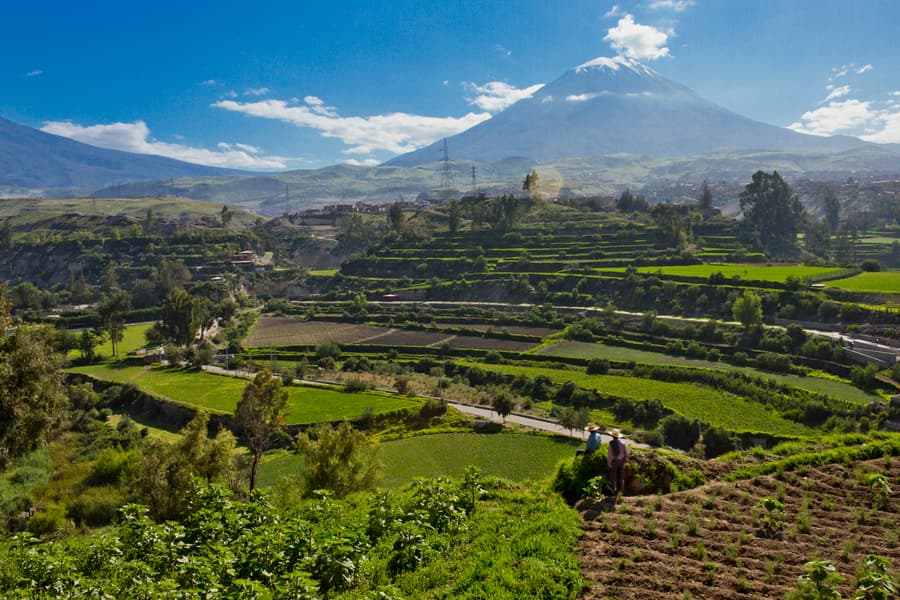
The shock arrives on day two. Day one you do the obvious things — walk the Plaza, look at the Cathedral, eat something unfamiliar at a restaurant you chose by pointing at the menu. By day two you've realized that Arequipa has more going on than most cities in South America manage in a week.
A UNESCO monastery with 420 years of history you can spend 3 hours in and still feel like you rushed it. A volcano you can actually summit. The world's deepest canyon 3 hours away, with condors you can almost reach out and touch. A food culture that has its own vocabulary, its own set of institutions — the picanterías — and dishes that simply don't exist anywhere else. The shock is that it all exists in one place. This guide is how to make the most of it.
Arequipa is also not overrun. Cusco absorbs the mass tourism; Arequipa gets the travelers who did a little more research. The result is a city that still functions as one — real markets, neighborhoods that aren't museums, restaurants where locals actually go for lunch. That changes the quality of the experience in a fundamental way.
Why Arequipa?
The argument is one of concentration. Most destinations have one or two exceptional anchors that make a city worth visiting. Arequipa has half a dozen, and several of them are world-class in isolation.
Santa Catalina Monastery is a UNESCO monument within a UNESCO World Heritage Site — 20,000 square meters of colonial city built on top of colonial city, with nuns still resident in one section, and walls painted orange and cobalt blue that don't look real in afternoon light. Volcán Misti stands at 5,822m and can be climbed without technical equipment. Colca Canyon drops 3,400 meters — more than twice the depth of the Grand Canyon — and Cruz del Condor in May gets you close enough to condors to see the color of their eyes. Mummy Juanita, at the Museo Santuarios Andinos, is one of the most extraordinary archaeological discoveries of the 20th century.
Add the sillar stone historic center (UNESCO World Heritage since 2000), Toro Muerto (the world's largest petroglyph field, four hours west), and a food culture with its own international recognition. Any one of these would make a destination. The city has all of them. And it's not overrun.
Culture & History
Santa Catalina Monastery
Founded in 1579 by the Dominican Order, Santa Catalina operated for almost four centuries as a complete city within the city — a sealed world not opened to the public until 1970. What's inside is extraordinarily well preserved: cobblestone streets, cells with nuns' personal effects left intact, cloisters painted in that orange and cobalt blue that has become the most recognizable image of Arequipa. The nuns still live in a separate section of the complex.
Allow two hours minimum; three if you move slowly and photograph seriously. The Friday night tour (7–9pm, candlelit, similar price to daytime entry) is markedly better than the daytime visit in terms of atmosphere and crowd size. Book at the ticket desk.
Arequipa Cathedral
The 17th-century twin sillar towers dominating the Plaza de Armas are free to enter. There's a tower climb option for panoramic views of the city and Misti — worth the additional cost if the sky is clear. The interior is sober compared to the city's Jesuit churches, which makes it a useful reset after Santa Catalina.
La Compañía de Jesús
The most ornate Baroque facade in Peru. Jesuit, free to view, two steps from the Plaza. The 17th-century sillar carving is precise in a way that makes you stop and wonder how it was done by hand with period tools. Don't walk past it without looking properly.
Museo Santuarios Andinos — Mummy Juanita
At La Merced 110, the museum is home to Juanita — the Inca girl sacrificed approximately 1450 CE on the summit of Volcán Ampato and discovered in 1995. The state of preservation is extraordinary: clothing, hair, and facial features intact after five centuries frozen at 6,310 meters. Book an English-language guide 24 hours ahead. Photography of the mummy is not permitted.
Casa del Moral
An 18th-century colonial mansion with one of the city's most elaborate Baroque doorways. The inner courtyard has the particular quiet that well-preserved places carry. Affordable entry fee; rarely crowded.
Santa Catalina (entry)
~S/.55
Museum Santuarios
~S/.30
Cathedral Tower
~S/.10
General hours
9am–5pm (Mon closed some)
Photography
Permitted at Santa Catalina, not the mummy
Friday night tour
7–9pm candlelit
Santa Catalina: buy the afternoon ticket
Adventure & Trekking
Volcán Misti — 5,822 m
Misti is the most recognizable mountain in Peru after Huascarán and the most accessible for climbers without technical high-altitude experience. The standard ascent is two days: day one to high camp at 4,600m, day two a pre-dawn push to the summit crater. Crampons aren't required except in late-season icy conditions, though carrying them is sensible. The Chiguata trailhead is the most common departure point. Recommended operators: Pablo Tour, Naturaleza Activa, Giardino Tours. Cost: approximately $60–120 per person all-in.
Chachani — 6,075 m
Technically easier than Misti but 253 meters taller — the starting point is already at 5,200m, which makes the ascent a single very long and demanding day rather than two. Summit views are extraordinary: Misti and the city to the south, the endless altiplano to the north, and on a clear day Ampato and other southern Peruvian volcanoes. Guide required. Cost: $70–130 per person.
Non-negotiable rule: neither peak without two to three days of acclimatization in Arequipa first. The city sits at 2,335m and the acclimatization here is real before stepping above 5,800m.
Misti summit
5,822 m
Misti duration
2 days / 1 night
Chachani summit
6,075 m
Chachani style
1 long day
Guide required
Both peaks — yes
Guide cost
$60–130 p/p
Acclimatize before you summit
Day Trips
The radius from Arequipa covers some of the most dramatic landscapes on the continent. Colca Canyon is three hours north — take the two-day tour to reach Cruz del Condor with time (8am, before the heat lifts the birds) and to spend the night in Chivay village, which has thermal baths. One-day tours exist but leave you rushed.
Toro Muerto, four hours west on the road toward the coast, is the world's largest petroglyph field: thousands of engravings on dark volcanic rock across a desert hillside that looks like nowhere else in Peru. Rarely visited — bring water.
Salinas-Aguada Blanca National Reserve, between Arequipa and Colca, is where you'll find vicuñas and Andean flamingos at 4,300 meters above sea level. Most Colca tours pass through here en route — it's not a detour.
Food Experiences
Cooking Classes
The best classes run 3–4 hours and include a market visit to buy ingredients — that alone is worth the morning. You'll learn rocoto relleno and chupe de camarones in most; some also cover adobo arequipeño and pastel de papa. Expect to pay $40–70 per person; book at least one day ahead.
San Camilo Market
The working heart of the city. Go between 7 and 10am for the best experience: the cooked food stalls in the center serve tamales and chicharrón from 6:30am. Don't treat it as a museum — it's a functioning supply market, and that's exactly its value. Breakfast here costs under S/.10 and is better than anything served in the center's hotels.
Picanterías — The Arequipeño Lunch
The picantería is Arequipa's gastronomic institution: a restaurant specializing in traditional Andean cooking, chicha de jora, and the main dishes that define regional cooking. They close by 3pm — go for lunch, not dinner. Most recommended: La Nueva Palomino in Yanahuara (the institution, slightly slower service), Tradición Arequipeña (larger, more group-friendly), Las Quenas (smaller, more local). At all of them, order whatever the adobo of the day is.
Rocoto relleno — what to know
Miradores & Views
The best mirador in the city is free and twenty minutes' walk from the center. Yanahuara Mirador — a colonial arcade with sillar arches that frame Misti directly — is perfect at 5pm when the volcano catches lateral light and the city starts lighting up below. No charge, no tourist cafeterias attached, and on weekdays no crowd.
Carmen Alto, north of the city, has full valley views. Sachaca, further west, is even more panoramic. The rooftops of the San Lázaro neighborhood — the oldest barrio in Arequipa, founded 1540 — are informal but give a perspective on the historic center that the official viewpoints don't offer. All free; none overcrowded except Yanahuara on weekend evenings.
Nightlife
The axis of Arequipa's nightlife is El Filtro district on Av. Jerusalén. Active Thursday to Saturday; other nights are quiet. Capitán Melville (Calle Ugarte) has the best cocktail program in the city with a focus on Arequipeño pisco. Casona Colca — colonial courtyard, live Andean music on weekends — is the most photogenic stop of the night. Wayra Peña has live folk music and dance. For clubs: Kibosh and Déjà Vu (Av. Ejército) run until 4am Saturdays.
Altitude warning: alcohol hits harder at 2,335m. This isn't suggestion — it's physiology. Drink water between drinks and don't use your normal tolerance as a reference.
Shopping
For quality alpaca: Claustralia and Millma on Calle Mercaderes. Both work with verified fiber and price accordingly. The alpaca sold by plaza vendors is mostly acrylic with small percentages of natural fiber — not worth what they charge. The difference in feel between real alpaca and acrylic is immediate once you know what to look for.
For ingredients: San Camilo market has the best dried and fresh rocotos in the city, ají panca paste to bring home, and quinoa varieties you won't find in Lima or abroad. Weekend artisan fairs on the Plaza de Armas have local ceramics and textile products from small producers.
Explore Specific Activities
Detailed guides with hours, prices, and insider tips for each activity.
All activities
Santa Catalina Monastery
20,000 sq meters of colonial city-within-a-city. Allow 2–3 hours.
Volcán Misti Trek
5,822m. Two days, one night at high camp. One of Peru's iconic climbs.
Chachani Trek
6,075m — higher than Misti, non-technical. Extraordinary altiplano views.
Yanahuara Mirador
Colonial arcade with the finest view of Misti in the city. Free. Always open.
Mercado San Camilo
The working heart of the city. Go hungry at 7am. Best breakfast in Arequipa.
Cooking Class
Learn rocoto relleno and chupe de camarones from local cooks. 3–4 hours.
Mummy Juanita Museum
The 500-year-old Inca girl found frozen on Volcán Ampato. Extraordinary.
Condors at Colca Canyon
3.2m wingspan. Cruz del Condor at 8am. Near-guaranteed sightings May–Nov.
Nightlife
El Filtro district, peñas, pisco bars. Active Thursday to Saturday.
Sillar Architecture Walk
Self-guided UNESCO walking tour through 400 years of volcanic stone Baroque.