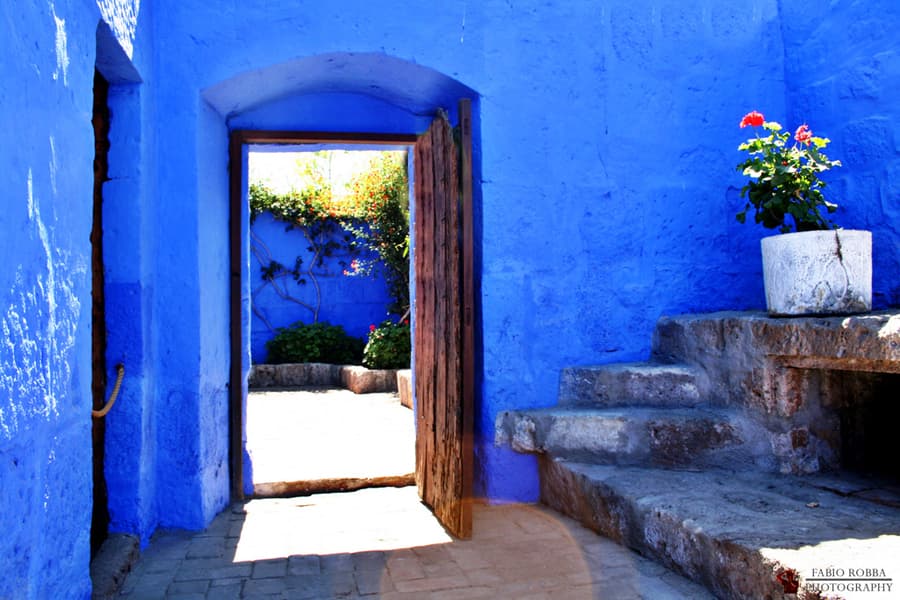
In 1970, after nearly four centuries of absolute enclosure, the doors of Santa Catalina Monastery opened to the public for the first time. What visitors found was extraordinary: a city within a city — 20,000 square meters of cobblestone streets, plazas, gardens, and individual convent apartments, all built in the 17th and 18th centuries from Arequipa's sillar stone, painted in brilliant crimson, orange, and vivid blue. The nuns who had lived there in complete seclusion had created, entirely unknowingly, one of the great architectural wonders of South America.
History
Founded 1579 by Doña María de Guzmán, daughter of a wealthy Spanish conquistador. Dominican order. For 391 years — from 1579 to 1970 — no outsider entered. The nuns inside had no contact with the outside world. They cooked, prayed, painted, gardened. The monastery grew organically, each generation building onto what the last had left.
Architecture and Layout
20,000 sq meters (about 4 city blocks). Divided into zones with names that feel more like a city than a convent: Calle Sevilla (the most photographed street — crimson walls, blue sky), Calle Granada (quieter, orange), Calle Córdoba (the oldest section). The Zocodover Cloister has the famous orange trees. The washing area (lavandería) has 20 large clay pots used for laundry built into a stone channel. The kitchen is from the 18th century, intact.
The Nuns
35 Dominican nuns still live in a cloistered section, separated from the tourist area. You might see their laundry drying, or hear the bells mark canonical hours. They have chosen enclosure voluntarily.
Photography
Permitted everywhere in the public sections. The famous shot: Calle Sevilla, midday when sun hits the crimson walls directly — arrive 10–11am for this. The blue doors against crimson walls are the image everyone wants.
Ticket Options and Hours
Mon–Sat 9am–5pm (last entry 4pm). Friday guided night tours 7–9pm (book at the ticket desk same day — limit 50 people). Entry ~S/.55 adults. Audio guide available. Guided tours in Spanish and English.
How Long
2 hours minimum, 3 hours if you explore carefully, 4+ hours for the Friday night tour with the full experience.
Don't Miss
The southern sections most tourists miss (follow the map all the way to the back — the quieter zones have the most atmospheric light). The individual nuns' cells (some are unlocked and show the complete apartment — bedroom, kitchenette, private garden, devotional space). The pinacoteca (painting collection) on the upper level.
Address
Calle Santa Catalina 301, Historic Center
Hours
Mon–Sat 9am–5pm, Fri until 8pm (night tour)
Entry
~S/.55 adults, S/.25 students
Area
20,000 square meters
Founded
1579
Active nuns
~35 (cloistered section)
The Friday night tour is unmissable
Calle Sevilla at 10:30am
🎫 Book Santa Catalina Monastery Entry
Guided tour included — skip the queue
Santa Catalina Monastery — Entry with GuideMust do
desde
USD 22
Santa Catalina: Private Tour with Local Historian
desde
USD 38
* Precios orientativos. Los links son de afiliado — no te cobran extra y nos ayudan a mantener arequipa.net gratuito.