Visit Arequipa
Peru's White City — UNESCO architecture, three volcanoes, and the country's most singular food culture.
Arequipa still belongs to its residents. That is changing. This guide is for those who arrive before it does.
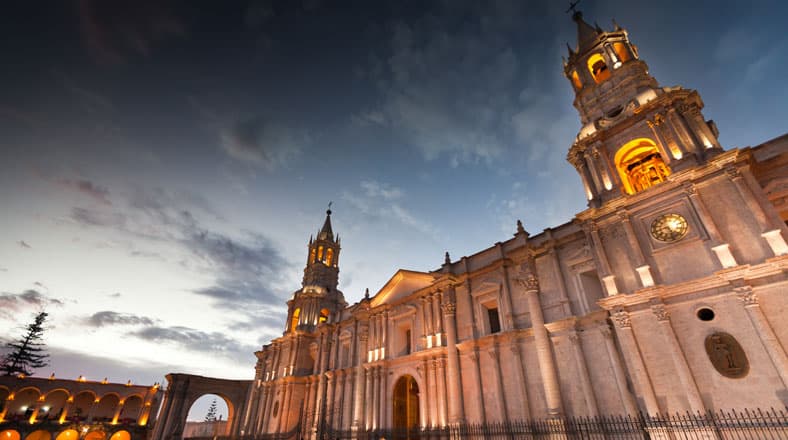
The bus from Lima arrives before dawn. You step out into cold, thin air — 2,335 metres above sea level — and the first thing that hits you is not the altitude. It is the smell: charcoal, eucalyptus, something faintly volcanic. Then the light comes, and the city reveals itself piece by piece: white sillar stone catching the first gold of the morning, volcanoes rising impossibly steep against a sky that at this altitude has almost a violet tint, cathedral bells rolling across the Plaza de Armas where the pigeons have not yet woken up.
Arequipa is Peru's second city in population, but in many ways first in character. It has a regional identity so deep that locals call themselves mistis — after the volcano that watches over the city — and carry a reputation for political fierceness and cultural independence dating to colonial times. It is not Lima. It is not Cusco. It is something entirely different: a city that built its historic centre from white volcanic stone called sillar, declared a UNESCO World Heritage site in 2000, and has had enough confidence in itself never to reinvent itself for tourists.
The food alone justifies the trip. Rocoto relleno — a large, blazing red chilli stuffed with spiced minced meat, raisins, and melted cheese — is so specific to Arequipa that ordering it in Lima feels like geographic plagiarism. Chupe de camarones is a river-prawn bisque so substantial and complex that Lima chefs have spent decades trying to replicate it without quite succeeding. Adobo arequipeño — pork marinated in chicha de jora and spices, slow-cooked for hours — is the traditional weekend breakfast, served before midday in the picanterías of the Sachaca valley. Those picanterías — informal family restaurants that have existed in their current form for generations — are UNESCO Intangible Cultural Heritage since 2021.
Then there are the volcanoes. El Misti (5,822 m) is perfectly conical, visible from almost anywhere in the city, and accessible enough that experienced trekkers reach the summit in two days without specialised equipment. Chachani (6,075 m) is technically higher but topographically gentler. Pichu Pichu (5,664 m) sprawls behind them like an old, eroded sentinel. On clear days of the dry season — and most days from May to November are clear — all three sit permanently in view, reminding you at every moment of the extraordinary geology on which this city was built.
Three hours by bus sits Colca Canyon, twice as deep as the Grand Canyon, where Andean condors launch from cliff ledges in the early morning with a three-metre wingspan and an indifference to spectators that borders on majesty. It is arguably the finest accessible wildlife spectacle from any city in Peru.
What sets Arequipa apart from its Peruvian tourist rivals — Cusco above all — is that it still belongs to its residents. The Plaza de Armas fills with arequipeños on weekend evenings, not just backpackers with maps. San Camilo market serves the neighbourhood cooks, not souvenir hunters. The restaurants of Yanahuara and Cayma exist because local people eat there regularly, not because they appear on TripAdvisor. That is changing gradually — direct flights from Lima have multiplied, hotel infrastructure has modernised — but the balance still tilts toward authenticity.
This guide is for the version of Arequipa that travel aggregators have not yet written: the city in its layers — architectural, gastronomic, volcanic, human. The city that rewards curiosity and punishes haste.
Why Visit Arequipa?
UNESCO inscribed Arequipa's historic centre in 2000. It was not a difficult decision. Few cities in the Americas have a comparable concentration of 17th-century religious and civil architecture built from a single material: sillar, a white volcanic stone quarried locally that turns golden at dawn and rose-dark at dusk. The Cathedral, La Compañía de Jesús, the Santa Catalina convent, San Agustín — each a study in how Andean baroque transformed European models into something genuinely its own.
Above the city rise three volcanoes so omnipresent that people stop seeing them, and then suddenly see them again and find them astonishing: El Misti (5,822 m), perfectly conical; Chachani (6,075 m), the highest and most silent of the three; and Pichu Pichu (5,664 m), the oldest and most eroded, spreading along the southern horizon.
Regional food is arguably the most underrated reason to visit. Arequipa has Peru's most distinct regional food culture — arguably more so than Lima — with dishes that exist in no other form anywhere else: rocoto relleno, chupe de camarones, adobo arequipeño, ocopa, queso helado. The picanterías where they are served are now UNESCO Intangible Cultural Heritage. Visiting Arequipa without eating in a picantería is like visiting Naples without eating pizza.
And Arequipa still belongs to its residents, unlike over-touristed Cusco. That is perhaps its hardest advantage to quantify and the easiest to feel the moment you arrive.
When to Visit
Arequipa has two clearly defined seasons, and both are good reasons to visit — for different reasons.
Dry season (May–November).The classic period. Days are sunny and clear with almost no exceptions, afternoons running 20–25°C. El Misti and Chachani are visible from dawn to dusk. Nights are cold: June and July can drop to 5°C or below, so bring a jacket. July and August are the trekking peak — Colca Canyon at its best, volcano trails dry — but also the most crowded. August 15th is the city's founding anniversary, the largest celebration of the year, with parades, fireworks, and artisan fairs lasting a full week.
Wet season (December–April). Afternoons bring showers — usually two to three hours, typically between 14:00 and 17:00 — but mornings are generally clear. The landscape turns green and volcanoes wear fresh snow. February is Carnival, a chaotic and genuinely local celebration. Tourist numbers are significantly lower than in July. Colca Canyon becomes harder at this time: trails grow slippery and some sections close.
Shoulder months (April and November). These are the best hinge months: mostly dry weather, comfortable temperatures, cheaper hotels, and shorter queues at Santa Catalina convent. November in particular offers extraordinarily clear days. If you can choose freely, November is the best-kept secret on the calendar.
Altitude. At 2,335 m, Arequipa causes soroche (altitude sickness) in many visitors — especially those arriving directly from sea level. Typical symptoms are headache, fatigue, and mild dizziness in the first 24–48 hours. Standard remedy: rest on day one, drink plenty of water, avoid alcohol the first 24 hours. If the headache is severe, Clínica Arequipa has oxygen. Those arriving from Cusco (3,400 m) will find Arequipa feels almost like relief.
Altitude
2,335 m / 7,661 ft
Best months
May – November
Dry season
May – Nov
Wet season
Dec – Apr
Avg high (dry)
23°C / 73°F
Avg low (dry)
8°C / 46°F
Book August early
Getting There
By air. Alfredo Rodríguez Ballón airport (IATA: AQP) sits 9 km north of the city centre. LATAM, Sky, and JetSmart operate multiple daily 1-hour flights from Lima. From Cusco, flights take about 45 minutes. No international flights serve AQP directly — all international arrivals connect through Lima.
By bus. Cruz del Sur and Oltursa run overnight services from Lima (16–18 hours, executive/suite class with near-flat seats). From Cusco, allow 9–10 hours via Juliaca and Puno. All buses arrive at the Terminal Terrestre on Av. Andrés Avelino Cáceres, about 4 km from the centre — taxi to the centre costs S/.12–15.
By road. The Pan-American highway south from Lima passes through Ica and Nasca — where you can add the Nasca Lines to your itinerary — across some of the most extreme desert scenery on the continent. Allow 14–16 hours by private vehicle. Plan fuel stops between Nasca and Arequipa: stations are scarce.
Airport
AQP (Rodríguez Ballón)
From Lima (air)
~1h 30m
From Cusco (air)
~45 min
From Lima (bus)
14–16 hours
From Cusco (bus)
8–9 hours
From Puno (bus)
5–6 hours
Neighborhoods
Historic Centre (Centro Histórico). The UNESCO core. Stay here if you can. The Plaza de Armas, Cathedral, Santa Catalina convent — a walled city within the city, 20,000 m² of convents, cloisters, and colour-washed streets — La Compañía de Jesús, San Agustín, and San Camilo market are all within 15 minutes on foot. Safe at any hour.
Yanahuara.A colonial hilltop barrio 2 km northwest, across the Chili river. The city's best mirador: a row of 19th-century sillar arches with El Misti perfectly framed behind. Local restaurants, quieter streets, 10-minute taxi to the centre. The Sunday market on the central plaza is small but excellent.
Cayma. Above Yanahuara, even more residential, great hilltop church (San Miguel de Cayma, 1707) with the clearest unobstructed view of El Misti in the city. At sunset, the volcano turns orange and rose. A 20-minute taxi ride that most tourists skip and should not.
Miraflores (Arequipa). Large commercial district around the Terminal Terrestre. Useful for transit; no reason to base yourself here.
Safety
Arequipa is one of Peru's safest cities for travellers — significantly safer than Lima, high-season Cusco, and any city in the Amazon region. The vast majority of visitors pass their stay without incident. Standard precautions still apply.
Historic centre, Yanahuara, Cayma are all low-risk day and night. The Plaza de Armas area and surrounds are well-lit and have constant police presence.
What to watch:Don't flaunt valuables or use your phone conspicuously in crowded markets or at the bus terminal. Use registered taxis (Radio Taxi or apps like Uber) at night — avoid hailing street taxis after 22:00. San Camilo market carries pickpocket risk in crowds; use a front-pocket bag. ATMs: use machines inside banks or shopping centres during daylight; count change on the spot.
Currency: Peruvian sol (PEN). Exchange rate 2025–2026 is around S/.3.70–3.80 per US dollar. Money changers on Calle San Juan de Dios offer better rates than banks — always count your notes before leaving.
Altitude and healthcare
Day Trips
Colca Canyon.100 km / 3 hours from Arequipa. The world's deepest canyon — twice the depth of the Grand Canyon. Andean condors launch from cliff ledges at Cruz del Cóndor most mornings before 10 am, with a three-metre wingspan and an indifference to spectators that borders on the majestic. Overnight stays in Chivay or Yanque allow two condor mornings and a dip in the La Calera hot springs at dusk.
Salinas & Aguada Blanca. High plateau reserve 30 km out on the road to Colca. Flamingos (three species) gather at Laguna Salinas in the wet season; vicuña herds are visible year-round. Most Colca tours stop here — it is practically en route.
Toro Muerto.World's largest petroglyph field, 4 hours west in the Majes valley. Over 5,000 engravings on volcanic boulders, primarily Wari and Tiwanaku, 8th–12th centuries. Virtually no other tourists. A local guide hired in the village of Corire is essential for orientation.
Where to Stay
Stay in the Historic Centre or Yanahuara — anywhere else adds unnecessary taxi costs and travel time.
Budget (S/.50–120 / under $30 per night). Casa de Sillar and Wild Rover Hostel are the most reputable options in the backpacker segment. Both have private rooms and dorms, are well-located in the centre, and have rooftop terraces with Misti views that make up for any minor inconvenience.
Mid-range boutique (S/.180–350 / $50–120 per night). Casa Andina Standard offers chain reliability with some local character. Hotel Libertador Arequipa and Hotel La Joya are solid options with breakfast included, English-speaking staff, and central locations. Worth comparing at time of booking.
Luxury (S/.450–700 / $150+ per night).Cirqa is without argument the finest hotel in the city — a 17th-century sillar mansion converted into a 16-room boutique hotel with a rooftop pool, exceptional breakfast, and design that respects the historic building without fetishising it. If you spend on one indulgence in Peru, spend it here. Also worth considering: Libertador Arequipa, Casa Andina Premium, and La Maison d'Elise. Book well ahead for July–August.
Practical Info
Currency. Peruvian sol (PEN). ATMs are widely available in the historic centre and malls. BCP, Interbank, and Scotiabank machines work reliably with international cards. Credit cards accepted at most restaurants and hotels. Always carry some cash for markets, picanterías, and taxis.
Altitude. 2,335 m. If arriving from sea level, take it easy on day one: rest, hydrate, avoid alcohol for 24 hours. Ascend from Arequipa to Cusco (3,400 m) in stages rather than rushing. Clínica Arequipa has oxygen for severe headaches.
Language. Spanish. Basic phrases are appreciated everywhere; English is spoken in tourist hotels and restaurants but rarely on the street or in markets.
Visas.Most nationalities — US, EU, UK, Canada, Australia — receive a free 90-day tourist stamp on arrival at the airport or land border. No advance paperwork needed. Check your country's specific requirements before travel.
Currency
Peruvian Sol (PEN)
Exchange (2025)
~S/.3.75 per USD
Emergency
105 police / 116 ambulance
Language
Spanish
Visa (US/EU/UK)
90 days, free on arrival
Best taxi app
Uber or InDriver
Explore in depth
Colca Canyon Day Trip
The world's deepest canyon, 3 hours from Arequipa. Condors every morning.
Arequipa vs. Cusco
How to choose between Peru's two most beautiful cities.
Best Time to Visit
Month-by-month guide: weather, crowds, and festivals.
Weather by Month
Temperature, rainfall, and what to pack every month of the year.
How to Get Here
Flights, overnight buses, and the Pan-American road trip.
Yanahuara
The colonial neighborhood with the city's finest mirador.
Cayma
Quiet hilltop barrio above the city, loved by locals.
Safety Guide
Honest, practical advice on staying safe in Arequipa.
Toro Muerto Petroglyphs
The world's largest petroglyph field, 4 hours from Arequipa.
Salinas & Aguada Blanca
Flamingo lagoons and vicuña herds on the high plateau.