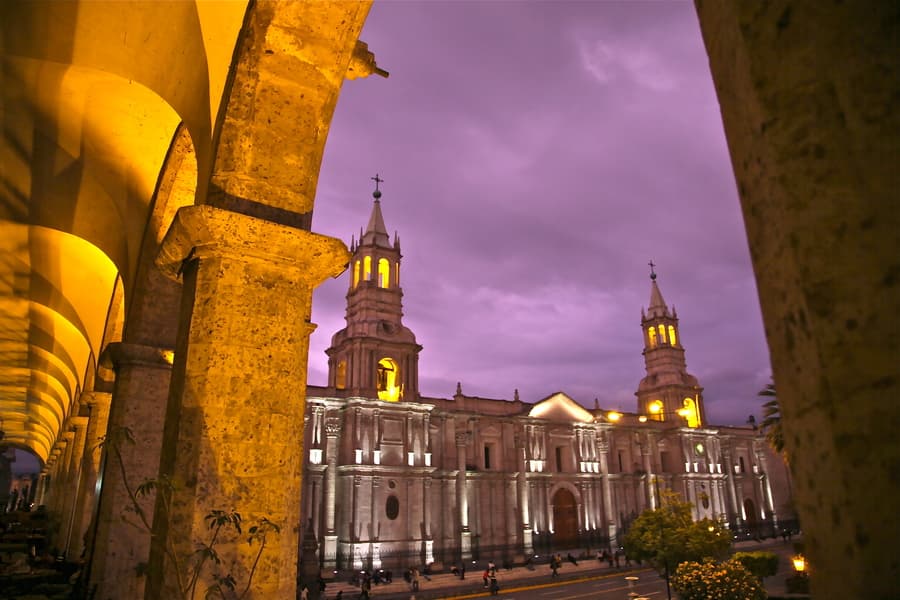
Arequipa and its identity
Founded
August 15, 1540
UNESCO Heritage
Year 2000
Nickname
The White City
Altitude
2,335 m.s.n.m.
Arequipa was founded on August 15, 1540 by Garcí Manuel de Carbajal, one of the first Spanish conquistadors in the Andes. What distinguishes the city is not only its age, but the material with which it was built: sillar, a white volcanic stone extracted from the flanks of the volcanoes surrounding the city — El Misti, Chachani, and Pichu Pichu. This porous white sillar, easy to carve and heat-resistant, gave Arequipa its nickname the White City and an architectural character unique in Latin America. The historic center, declared a UNESCO World Heritage Site in 2000, concentrates more than 400 years of continuous sillar construction: baroque churches, colonial convents, mansions of distinguished families, and arcades lining the Plaza de Armas.
5 Centuries of Living History
Before the arrival of the Spanish, the valley of Arequipa was inhabited by the Collagua, an Andean people who developed a terraced agricultural culture on the slopes of the Colca. The name "Arequipa" likely derives from the Quechua "Ari-quepay" — "yes, stay here" — a phrase the Inca Mayta Cápac allegedly said when his soldiers did not want to leave the fertile valley. The Spanish conquest brought sillar architecture, evangelization, and the reconfiguration of urban space. The city grew around the Plaza de Armas, with the cathedral to the north, the cabildo to the south, and convents distributed throughout the colonial fabric. Arequipa has suffered devastating earthquakes — in 1582, 1600 (with the eruption of Huaynaputina, the largest volcanic eruption in South American history), 1868, and 2001 — and each time was rebuilt in sillar, reinforcing with each reconstruction the visual identity of the city.
Culture and Arequipeña Identity
The "independent republic of Arequipa"
This phrase is not a tourist joke. It reflects a real sentiment: Arequipa has its own dialect (Arequipeñismo includes words and constructions found nowhere else in Peru), its own cuisine, its own music (the yaraví, the most melancholy rhythm of the Andes), and a historical distrust of Lima that dates back to colonial centuries. To call someone "arequipeño/a" is a title of honor that its bearers defend with genuine pride.
Arequipeña identity was built in opposition to Lima from the first colonial centuries. Arequipa was a rich, cultured, and distant city — more closely connected to Potosí and the trade of the Altiplano than to the viceregal capital on the coast. This geographical and economic distance generated a culture of self-sufficiency that persists. Arequipeños speak of their city with a love bordering on mythology: the sillar, El Misti, the Sunday adobo, the queso helado, the Yanahuara mirador. These are not folklore elements for tourist consumption — they are the pillars of an identity transmitted from generation to generation that differentiates Arequipa from the rest of Peru in a way no other Peruvian city can claim.