Pre-Hispanic origins
Before the Spanish conquistadors arrived, the valley where Arequipa now stands was inhabited by the Collagua, an Andean people who developed a sophisticated terraced agricultural culture on the slopes of the Colca Canyon. The Collagua were incorporated into the Inca Empire under the reign of Mayta Cápac, who according to oral tradition was so impressed by the fertility of the valley that when his soldiers did not want to leave, he said "Ari-quepay" — in Quechua, "yes, stay here." This is the most likely origin of the name Arequipa, though scholars debate other possible etymologies.
The Spanish foundation (1540)
On August 15, 1540, the feast day of the Assumption of the Virgin, Garcí Manuel de Carbajal officially founded Villa Hermosa de Arequipa by order of Viceroy Francisco Pizarro. It was one of the first Spanish cities established in the Andes, strategically located as a commercial node between Lima and Potosí. Arequipa's position — at 2,335m altitude, in a fertile valley with access to the Altiplano and the coast — quickly made it one of the most prosperous cities of the viceroyalty. Its wealth came from the trade of alpaca and llama wool, Altiplano minerals, and agricultural products from the Colca valley.
Sillar: the stone that defines the city
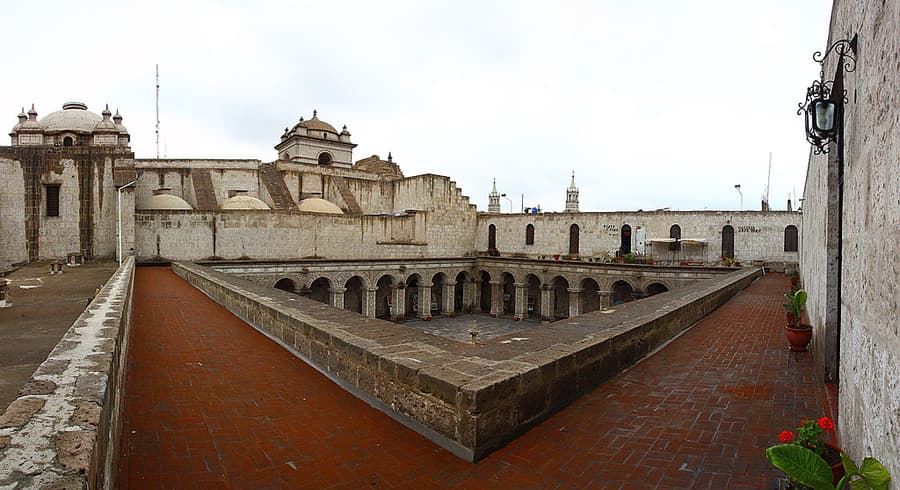
Sillar is a white pyroclastic volcanic tuff, a product of the historical eruptions of Chachani and El Misti. Its porous texture makes it extraordinarily easy to carve with basic tools, and its mineral composition gives it a natural resistance to heat and temperature changes. Arequipa's 16th-century stonemasons discovered that this material was ideal for construction in the city's dry, high-altitude climate: it does not absorb ground moisture, preserves well over centuries, and allows ornamental details impossible with harder stone. The result is a city that literally shines under the Andean sun — every church, every mansion, every doorway seems carved from a single block of white alabaster.
Earthquakes and reconstructions
Arequipa has been destroyed and rebuilt several times. The 1582 earthquake damaged much of the center. The eruption of Huaynaputina in 1600 — the largest volcanic eruption recorded in South American history — blanketed the city in ash and devastated regional agriculture, causing an economic crisis that lasted decades. The 1868 earthquake was the most destructive of the modern era: it destroyed virtually all of the historic center. The subsequent reconstruction paradoxically solidified the city's architectural identity: Arequipeños rebuilt in sillar, more carefully than before, with more elaborate baroque ornamentation. The last major earthquake, in 2001 (8.4 Mw), damaged structures throughout the center and required extensive restoration that lasted more than a decade.
UNESCO World Heritage (2000)
In 2000, the Historic Center of Arequipa was inscribed on the UNESCO World Heritage List as an outstanding example of Spanish colonial architecture that incorporates native Andean elements. The criterion was specific: not only age or scale, but the singular fusion of local sillar with the European baroque style, mediated by mestizo stonemasons who incorporated iconographic motifs from Andean culture into the relief work on facades. This fusion — called "mestizo baroque" by art historians — makes Arequipa a unique case in Latin American architecture.
Year founded
1540
Historic eruption
Huaynaputina, 1600
UNESCO
Heritage, year 2000
Recent earthquake
June 23, 2001 (8.4 Mw)
The name that is an invitation
The name "Arequipa" probably means "Yes, stay" in Quechua — an invitation that remains valid 500 years later.