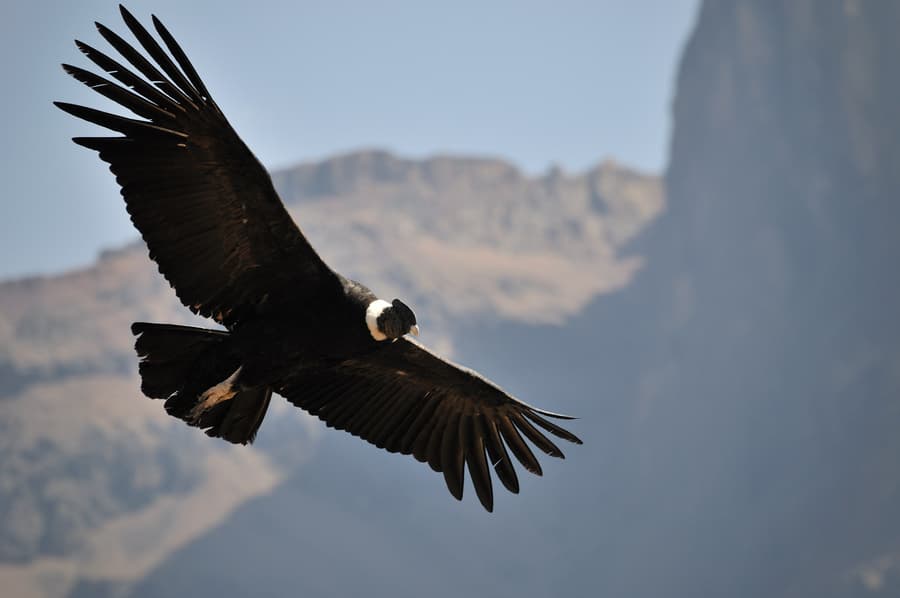
The condor rises from below the rim. You hear it before you see it — a sound like a flag in wind, the 3.2-meter wingspan catching the updraft from 3,400 meters of canyon below. Then it clears the edge, and it's right there, at eye level, banking on a thermal, studying you with one orange eye. This happens every morning at Cruz del Condor. It's one of the reliable miracles of the natural world.
What the Andean Condor Is
Vultur gryphus — not a true vulture but related to storks, the largest flying bird in the world by wingspan (up to 3.2m, weight up to 15kg). Andean condors are sacred in Andean cosmology — messengers between the living and the dead, linked to the sun god Inti. Globally vulnerable: approximately 10,000 individuals remain. They live 70+ years, mate for life, and raise one chick every two years. They don't kill — they find dead animals. Their primary food sources are llama and vicuña carcasses on the altiplano.
Why Cruz del Condor Works
The geometry of the canyon funnels morning thermals precisely to this viewpoint. Condors roost in the canyon walls at night; as the sun warms the rock, warm air rises from the canyon floor and the birds ride it effortlessly upward. Cruz del Condor sits exactly where these thermals emerge. This is not accident — generations of Colca communities have known it. The condors don't perform for tourists; they're doing what they always do.
The Experience
At 7–10am the condors spiral upward past the viewpoint level, sometimes within 10 meters. A typical morning produces 3–8 individual condors visible simultaneously. They soar without flapping — the massive wings locked in position, riding thermals with minimal effort. Photography: telephoto lens ideal (200mm+), but visible clearly with the naked eye.
Viewing Tips
Position on the right side (western end) of the viewpoint — condors approach from the east, so the right side sees them coming head-on. Arrive by 7:30am for the earliest birds. Don't walk around the viewpoint when condors are nearby — rapid movement can disturb them. The birds sometimes land on nearby rocks within the viewpoint area.
Sighting Reliability
Near-guaranteed May–November (dry season, stable thermals). Less certain December–April (clouds reduce thermal formation and the birds may not come to this altitude). Even in the wet season, mornings are usually clear — many visitors still see condors in December.
Getting to Cruz del Condor
150km from Arequipa (3–3.5h drive). Almost all visitors come on organized tours. The Colca Canyon tour includes a Cruz del Condor stop — book 1-day or 2-day from Arequipa operators. Self-drive possible on paved road; you'll need a car and the entry fee for the canyon (~S/.35 foreigners, included in tours).
Location
Cruz del Condor viewpoint, 150km from Arequipa
Condor wingspan
up to 3.2m (world's largest flying land bird)
Best viewing hours
7am – 10am
Reliable season
May – November (dry season)
Viewpoint altitude
3,287m
How to get there
Colca Canyon tour from Arequipa
Right side of the viewpoint — always
The 2-day tour sees them twice
🎫 Book Your Colca Canyon Tour
Tours with expert condor guide included
Colca Canyon 2 Days — Guaranteed Cruz del CondorMost popular
desde
USD 65
Colca Tour with Condors and Hot Springs
desde
USD 72
* Precios orientativos. Los links son de afiliado — no te cobran extra y nos ayudan a mantener arequipa.net gratuito.