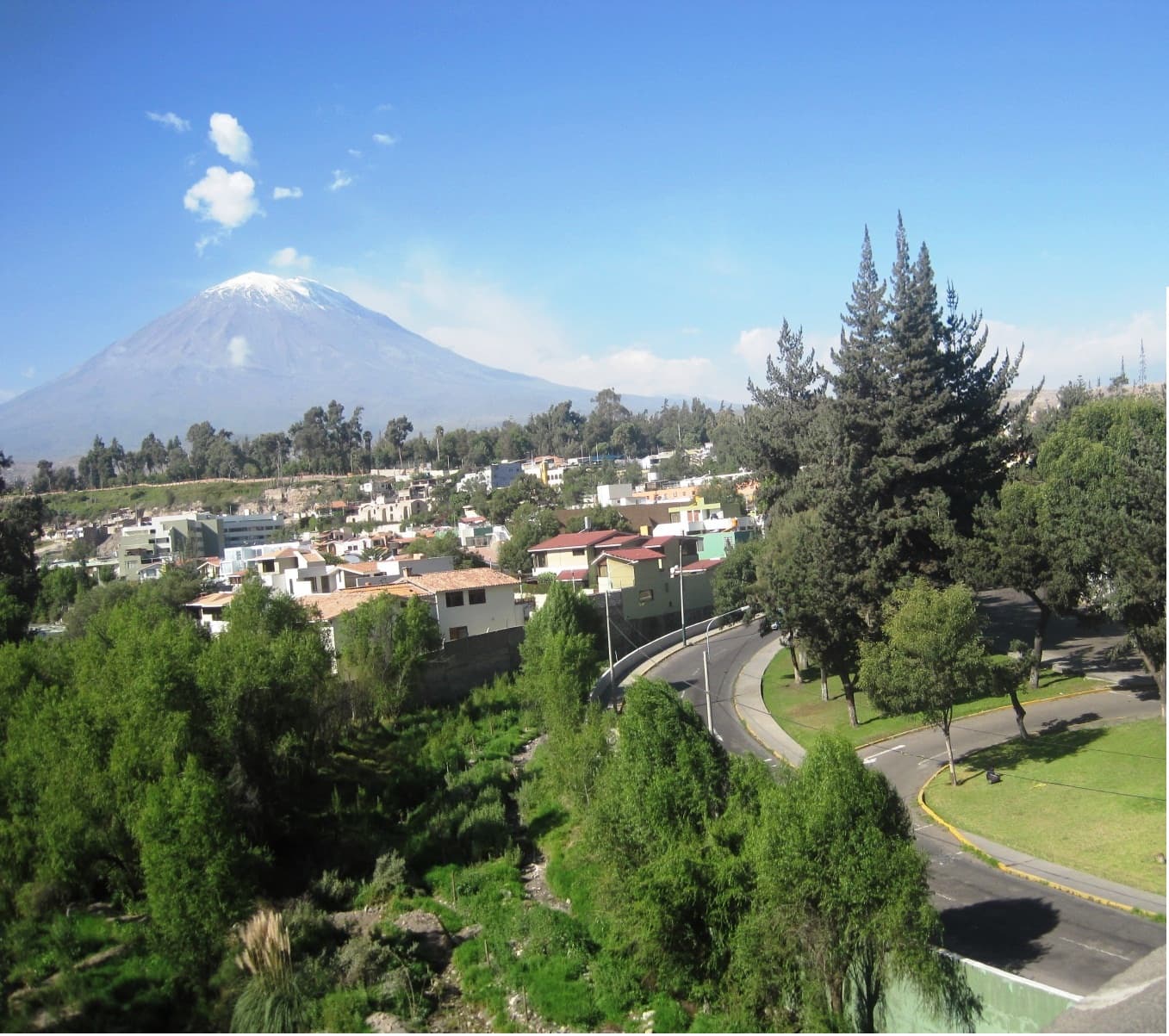
Arequipa doesn't appear on most relocation radars. That's exactly the point. While Cusco has become a tourist circuit and Lima a soul-draining traffic labyrinth, the White City has remained one of South America's best-kept secrets for those who know to look. A city of one million with UNESCO World Heritage colonial architecture carved from white volcanic stone, a food scene that rivals any Latin American capital, and a climate the locals describe without irony as eternal spring: sunny by day, cool at night, rain only December through March.
The cost of living that makes it all possible: a one-bedroom apartment in Yanahuara — the city's most elegant colonial neighborhood — runs $200–$350 a month. A meal at a decent restaurant, $5. Fiber optic internet, $18. The full total of a comfortable lifestyle — with restaurant dinners, culture, and weekend escapes to Colca — sits at $800–$1,200 for a single person. This isn't impoverishing yourself abroad; it's choosing to live better for less.
Why Arequipa?
Population
1.08 million
Altitude
2,335 m / 7,660 ft
Climate
300+ sunny days/year
Time zone
PET (UTC−5), no DST
Internet
100–300 Mbps fiber available
vs Lima
40–50% cheaper
The argument for choosing Arequipa over other popular relocation destinations in Latin America isn't one thing — it's an accumulation. Safe city, exceptional climate, active expat community, competent private healthcare infrastructure, 100–300 Mbps fiber in the main neighborhoods, and a cost of living index that makes cities like Medellín or Mexico City look expensive by comparison.
The altitude requires adjustment. At 2,335 meters, newcomers experience soroche for the first two or three days: headache, fatigue, reduced appetite. It is temporary. Acclimatization is complete within a week. The payoff is a climate Arequipeños never tire of describing as the envy of Lima: near-guaranteed sun almost every day of the year, an average annual temperature of around 17°C, and cool nights that make sleeping without air conditioning possible even in January.
The city is the right size. At one million people, Arequipa has everything a complete urban life requires — top-tier private hospitals, universities, shopping centers, restaurants of every type — without Lima's cognitive and logistical overload. Everything essential is within 20 minutes by Uber.
Cost of Living
1BR Apartment (Yanahuara)
$200–350/mo
Groceries (1 person)
$80–120/mo
Restaurant lunch
S/.15–25 (~$4–7)
Fiber internet
S/.60–90/mo (~$15–25)
Gym membership
S/.80–120/mo (~$20–30)
Comfortable budget
$800–1,200/mo
The numbers above are not aspirational — they are the actual prices in 2025–2026 in the neighborhoods where most expats live. Rent is the biggest variable: Yanahuara costs more than Cayma, which costs more than Cercado, which costs more than Paucarpata. For most people, the optimal balance is Yanahuara or Cayma: higher expat infrastructure quality, at prices that are still a fraction of what they would be in Europe or North America.
Food is where the cost of living is felt most immediately. A three-course lunch at a picantería — soup, main with rice and salad, dessert and chicha — costs S/.18–25, around $5–7. Cooking at home is even cheaper: the San Camilo market has fruits, vegetables, meat, and fish at prices European markets cannot imagine. A $120/month budget covers excellent eating for one person cooking mostly at home.
The comfortable life at $900/month
Best Neighborhoods
The choice of neighborhood defines the experience of living in Arequipa more deeply than any other single factor. Each neighborhood has its own character, its own price-to-quality ratio, and its own expat profile.
Yanahuara is the center of gravity of the expat community. A twenty-minute walk from the historic center, across the Río Chili, it has the highest concentration of cafés with fast internet, restaurants with English menus, and neighbors who speak the language. The sillar arch mirador — with El Misti perfectly framed behind — is five minutes away. Rent is the highest of the expat neighborhoods: $250–350 for a furnished one-bedroom in good condition.
Cayma sits above Yanahuara on the hillside, quieter and more local. Prices are 15–20% lower. The church of San Miguel de Cayma (1707) has the best unobstructed views of El Misti in the entire city. An excellent option for those who want calm and proximity to Yanahuara without paying Yanahuara prices.
Cercado / Historic Centre is the most central option and, in some renovated apartments, competitive on price. The advantage is obvious: everything walkable. The disadvantage is noise and lower direct expat infrastructure. Better for short stays or those who prioritize location over neighborhood atmosphere.
Miraflores is the neighborhood around Terminal Terrestre. There is no reason to live here.
Start in Yanahuara
Visas & Legal Status
Tourist visa
183 days, renewable
Rentista visa
$1,000+/mo passive income
Border run
Tacna by bus, 4 hours
Migraciones
Calle Urquiaga 203, Arequipa
Extension fee
S/.60 at Banco de la Nación
Peru automatically gives most Western passports 90 days tourist entry on arrival. Those 90 days are extendable to 183 days at the Arequipa Migraciones office (Calle Urquiaga 203, no appointment needed, S/.60 at Banco de la Nación, same day). The annual cap is 183 days within a calendar year.
The rentista visa requires proving passive income of at least $1,000/month (pension, investments, rental income) and allows indefinite residency with annual renewal. The process is manageable from Arequipa with an immigration lawyer — expect 3–6 months of processing.
Other categories exist: work visa (to work for Peruvian companies), student visa (to study Spanish at an accredited institution), and investor visa (minimum $30,000 investment in the country). A specialist immigration lawyer in Arequipa costs $150–300 for the initial consultation and visa plan, and is entirely worth it before making decisions.
The 183-day rule
Healthcare
Top private clinic
Clínica Arequipa
Specialist consult
S/.80–200 (~$22–55)
Dental cleaning
S/.80–120
Pharmacy chains
InkaFarma, Mifarma
International insurance
$50–150/mo
Arequipa's private healthcare system is genuinely good by South American standards. Clínica Arequipa (corner of Bolognesi and Puente Grau) is the reference center: internal medicine, cardiology, surgery, laboratory, diagnostic imaging — all under one roof, with doctors trained at Peruvian universities and some abroad. Many speak English. Prices are 70–80% lower than in the US and 40–50% lower than in Western Europe.
International health insurance is the logical base for expats: the most basic plans from SafetyWing or Cigna Global cost $50–150/month depending on age and coverage. It covers medical evacuation, which is the most relevant risk in case of a serious accident. Peruvian local insurance (EsSalud) is not available to foreigners without a formal employment contract.
Altitude and health: the first 48–72 hours are the hardest. Paracetamol for the headache, constant hydration, no alcohol the first day, minimal physical activity. If symptoms are severe or don't improve, Clínica Arequipa has supplemental oxygen. Acetazolamide (Diamox) is effective for prevention — consult a doctor before taking it.
Banking & Finances
Main banks
BCP, Interbank, BBVA, Scotiabank
ATM fee
S/.10–15 per withdrawal
USD accounts
Available at most banks
International transfers
Wise, Remitly
Opening a Peruvian bank account as a foreigner is possible but has specific requirements that vary by bank and visa type. BCP and Interbank are the most flexible for non-residents; BBVA and Scotiabank have stricter processes. What almost all require: passport, foreigner's card (CE) or proof of temporary residency, and sometimes a reference letter. Some expats opt to operate only with Wise and ATM withdrawals for the first months, which works well.
Wise is the fundamental tool for moving money internationally. The exchange rate is the real rate (no bank spread), fees are minimal, and the transfer arrives in minutes. Remitly is a solid alternative for transfers from the US. ATMs charge S/.10–15 per withdrawal regardless of issuing bank — using Wise to convert and withdraw in soles is the most economical strategy.
The exchange rate in 2025–2026 is approximately S/.3.70–3.80 per US dollar. The cambios (exchange houses) on Calle San Juan de Dios offer marginally better rates than banks for cash amounts. Avoid exchanging at the airport.
Daily Life
Transport
InDriver and Uber operate in Arequipa and are the recommended mode of transport for in-city trips. A typical ride in Yanahuara or the center costs S/.6–12 ($1.50–3). Airport to center: S/.25–35. Combis (minibuses) cost S/.1.20 and cover the whole city, but routes require local knowledge to use efficiently. No car is needed in Yanahuara or the historic center — the taxi app infrastructure makes personal vehicle ownership unnecessary for most.
Supermarkets
Plaza Vea is the most complete supermarket in the city — it has the widest variety of imported and domestic products. Tottus is a solid alternative with similar prices. For fresh produce, Mercado San Camilo is unbeatable: fruits, vegetables, meat, and fish directly from regional producers at prices supermarkets cannot match. The standard expat combination: San Camilo for fresh, Plaza Vea for packaged goods.
Internet
Movistar and Claro offer 100–300 Mbps fiber in the main neighborhoods. Installation takes 3–7 business days. Claro has a reputation for faster installation; Movistar for greater stability. For mobile data, a Claro or Bitel SIM with a S/.30–50/month data plan covers a digital nomad's needs comfortably.
Climate and health
Altitude sun burns even in winter — SPF 50 is mandatory, not optional. Nights are cool all year: 8–12°C even in summer. June through August, pre-dawn temperatures can drop to 4–6°C and mornings are definitively cold until 10am. A good fleece and a light rain jacket cover virtually the whole year.
Finding Your Community
Arequipa's expat community is small (estimated 3,000–5,000 people), which is an advantage: they know each other. English-language Facebook groups ('Expats in Arequipa', 'Arequipa Expats & Travelers') are the main entry point: questions about plumbers, doctors, apartments, and events appear and get answered within hours. The tone is genuinely helpful.
Co-working spaces are the second axis. Shared desks concentrate much of the expat social life: it's where solo digital nomads meet regularly, exchange client referrals and neighborhood recommendations, and organize weekend plans. The Saturday morning café in Yanahuara is where newcomers meet veterans.
Integration with locals is possible and enriching; fluent Spanish accelerates the process considerably. Arequipeños have a reputation for being more reserved than Limeños at first contact, but more loyal once the relationship is established. Arequipeño Spanish is considered the clearest and most neutral in Peru — excellent to learn, and the city's Spanish schools are good and inexpensive.
For digital nomads: the Nomad List and IndieHackers communities have a presence in Arequipa, and co-working infrastructure has grown significantly since 2022. The city doesn't have Medellín's volume, but it also doesn't have the saturation: those who are here tend to be here by genuine choice, not because it's the fashionable destination.
Detailed Guides
Cost of Living
Rent, groceries, utilities, and what a comfortable life actually costs.
Visa Guide
Tourist visas, rentista, border runs, and the path to residency.
Best Neighborhoods
Where expats actually live — Yanahuara, Cayma, Miraflores, and more.
Digital Nomad Guide
Internet speeds, co-working spaces, and the best cafés to work from.
Healthcare
Private clinics, international insurance, and what to know about altitude.
Banking
Opening accounts, ATMs, and moving money internationally via Wise.
Real Estate
Renting vs. buying, price per sqm by neighborhood, and the legal process.
Spanish Schools
Why Arequipeño Spanish is the clearest in Peru — and where to learn it.
Expat Community
Facebook groups, meetups, co-working communities, and how to plug in.
Moving Checklist
Everything to do before you arrive, in your first week, and first month.