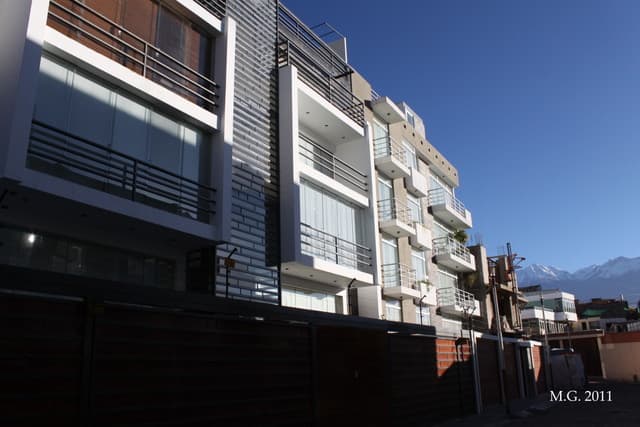
Foreigners can buy property in Peru with no restrictions. This is not an opinion or a generous interpretation of the law — it is enshrined in Article 71 of Peru's Constitution. Foreign nationals have exactly the same property rights as Peruvian citizens: no restrictions by nationality, location, or property type. Arequipa, as Peru's second city, has an active real estate market with options ranging from modern apartments in Cayma to colonial sillar houses in Yanahuara.
Can foreigners buy property in Peru?
Yes, fully and unconditionally. Article 71 of Peru's Constitution establishes that foreigners have the same property rights as Peruvian citizens. No Peruvian partner is required, no special government authorization, no geographic restrictions (except within 50km of international borders, which does not affect Arequipa), and no nationality quotas.
The legal purchase process is identical to that of a Peruvian citizen. The only administrative difference is that you will need a RUC (Registro Único de Contribuyentes — Peru's tax ID number) to formalize property transactions. It is obtained free of charge at any SUNAT office with your passport, in approximately 30 minutes.
Market Overview 2025
Arequipa's real estate market has five main expat zones, each with its own price profile and demand characteristics.
<strong>Yanahuara</strong> is the premium market. White sillar colonial renovations command the highest prices ($1,200–1,800/sqm). New construction is limited due to UNESCO World Heritage adjacency. Long-term historical appreciation has been solid, and rental demand from expats is consistent.
<strong>Historic Center</strong> has UNESCO-protected structures, making renovations complex (requiring DDCC approval — the regional culture authority). However, prices for raw colonial buildings can be attractive ($700–1,100/sqm). Buyer beware: renovation restrictions are strict and approval timelines are long. Suitable for experienced buyers with patience.
<strong>Cayma</strong> offers growth and mix: newer construction alongside colonial heritage. Prices range $900–1,400/sqm depending on view and building type. Cayma's newer developments have moved significantly upward in price over the last three years.
<strong>Miraflores</strong> is the most accessible price point ($600–900/sqm), good for rental investment oriented toward the local market. Less prestige than Yanahuara, but solid on yield.
<strong>Sachaca</strong> offers larger land plots, houses with gardens, and lower density at $500–800/sqm. Ideal for those seeking a quieter lifestyle with more space.
What You Get at Each Price Point
Purchase budgets in Arequipa have different reach depending on the neighborhood:
- $80,000–120,000: Furnished 1BR apartment in Yanahuara or a well-located studio (~60–80sqm). This budget in Miraflores or Sachaca can reach a 2BR apartment.
- $120,000–180,000: Spacious 2BR in Yanahuara or a 3BR apartment in Cayma. At this level, options with Misti views start appearing.
- $180,000+: Colonial house with interior courtyard in the Historic Center, or a modern 3BR apartment with garage in Yanahuara or Cayma. Some exceptional colonial renovations in Yanahuara fall in this range.
The Buying Process Step by Step
- Find the property. The main platforms are Urbania.pe and Adondevivir.com. Local agents have their own listings — Peru has no centralized MLS. Expat Facebook groups are useful for agent recommendations.
- Make an offer. Verbal first, then written. Negotiation is normal: a 5–10% discount from the listed price is standard. There is no fixed-price culture.
- Reservation agreement (minuta de separación). A deposit of S/.1,000–5,000 takes the property off the market while due diligence is completed.
- Title search (estudio de títulos). Hire a notary to verify that there are no liens, mortgages, or disputes on the property. Do not skip this step — it is the most important verification in the process.
- Promise of sale (promesa de compraventa). A detailed contract establishing conditions, price, and closing timeline (typically 30–60 days). Usually 10–30% of the price is paid at this stage.
- Final deed (escritura pública). Signed before a notary. The transfer is registered at SUNARP (Peru's public property registry). From registration, you are the legal owner.
- Pay alcabala tax. Municipal transfer tax of 3% of the value above 10 UIT (~S/.46,000). Paid at the municipality before or at closing.
Costs to Budget
Beyond the purchase price, buyers in Arequipa should budget for the following transaction costs:
- Notary fees: ~0.5–1% of purchase price
- SUNARP registration: ~S/.200–500 depending on value
- Alcabala (transfer tax): 3% of value above S/.46,000 (~10 UIT)
- Real estate agent commission: 2–5% (sometimes paid by seller, sometimes buyer — negotiated)
- Legal review: S/.500–1,500 for a lawyer to review the title and contract
- Total transaction costs: typically 4–6% of purchase price
Rental Yield Analysis
A S/.400,000 (~$108,000) apartment in Yanahuara rents for $280–320/month. Gross yield is approximately 3.5%. Net yield after maintenance, vacancy, and taxes sits around 2.5–3%.
Not a high-yield investment in isolation. But for long-term residents who plan to live there, the combination of appreciation and personal use changes the calculus. Arequipa's premium neighborhoods have maintained historical appreciation of 4–6% per year in dollar terms, which improves the total return.
Working with Local Agents
Peru has no MLS — each agent has their own listings. This means you need to speak with several agents to get a complete picture of the market. Commission is negotiable (2–5%). Ask for agent recommendations in expat Facebook groups — personal reviews are more reliable than any ratings platform.
Red flags: agents who pressure quick decisions, refuse to provide title documentation, won't let you bring your own notary or lawyer, or are evasive about property encumbrances.
The RUC and Other Administrative Prerequisites
The RUC (Registro Único de Contribuyentes) is Peru's tax ID number used in property transactions. It is free, obtained at any SUNAT office with your passport, and the process takes about 30 minutes.
The cédula de extranjería (foreign ID card) is useful for signing contracts and at the registry, but is not legally required for the purchase itself. If buying remotely, a Peruvian notarized power of attorney allows someone else to sign on your behalf.
Price/sqm Yanahuara
$1,200–1,800
Price/sqm Historic Center
$700–1,100
Price/sqm Cayma
$900–1,400
Gross rental yield
~3.5%
Transfer tax (alcabala)
3% above 10 UIT
Foreigner rights
Identical to Peruvian citizens
Foreigners can own property in Peru — no restrictions
Rent for at least six months first