The Purple Month in Arequipa: The Lord of Miracles Beneath El Misti
Every October Arequipa turns purple. Brotherhoods carry the Lord of Miracles on litters through the historic centre, the air smells of incense and Doña Pepa turrón, and a city that thinks of itself as very white and very colonial remembers that it is also deeply devout.
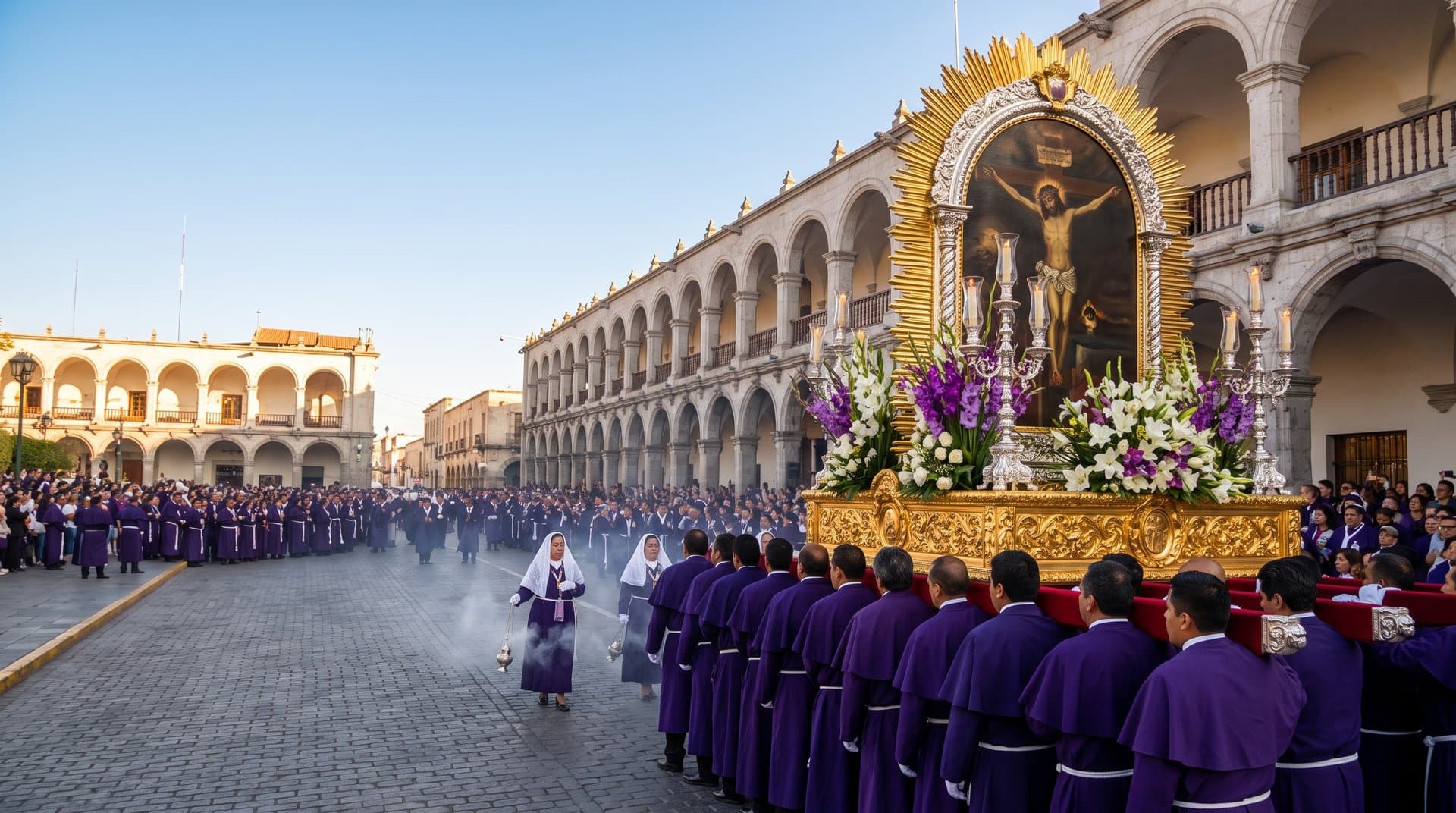
If you walk through the centre of Arequipa in October, the first thing you notice is the colour. Suddenly half the shops on Jirón San Juan de Dios and Calle Mercaderes appear dressed in purple: habits with a white cord, purple ribbons hanging from sillar balconies, florists selling nothing but flowers in wine and violet tones. This is the Mes Morado, the Purple Month, the season of the Lord of Miracles: the most massive Catholic devotion in Peru, which arrived from Lima but which Arequipa made its own more than a century ago. However much the city boasts of its cathedral and colonial cloisters, in October it becomes clear that its faith does not live in temples alone: it takes to the street, climbs onto a silver litter, and walks among the people.
From Lima to the White City: How the Devotion Arrived
The original image of the Lord of Miracles, a dark-skinned Christ painted on a wall by an Angolan slave in the seventeenth century in the Lima district of Pachacamilla, survived the earthquakes that flattened everything around it, and that resistance to the quake turned it into a symbol. In a city like Arequipa, scarred by its own earthquakes, that story struck deep. Local brotherhoods organised around parishes in the centre and in traditional neighbourhoods, and today the Arequipa procession draws thousands of bearers, incense-women, and singers who take turns carrying the litter along a route that usually passes the Plaza de Armas, the Basilica Cathedral, and the streets of the old quarter. The litter is not light: it weighs hundreds of kilos and advances at a short, rocking pace, borne by teams of purple-clad carriers who relieve one another every few blocks.
The organisation is meticulous and profoundly communal. Each brotherhood has its numbered squads, its sahumadoras, women who walk ahead of the litter perfuming the air with incense, and its cantoras, who intone the verses of the hymn "Señor de los Milagros" that, in October, is heard on every corner. Being a bearer is no ordinary turn: many inherit the post from a father or grandfather, and carrying the litter is a promise kept year after year. Around it, the city reorganises itself: streets close, police and city wardens direct the traffic, and the colonial balconies fill with neighbours watching the image pass from above, some tossing petals.
In October Arequipa remembers that its faith does not fit inside the cathedral: it climbs onto a litter and walks, at a short pace, among the people.
Doña Pepa Turrón and the Taste of the Purple Month
No Peruvian devotion makes sense without its food, and the Lord of Miracles has a sweet protagonist: turrón de Doña Pepa, a dessert of anise-dough sticks bathed in chancaca syrup and crowned with coloured sprinkles. In October it appears in every bakery and on carts around the centre; a medium box costs around S/ 15 to S/ 25 depending on the size and the quality of the syrup. Legend says it was created by an enslaved woman named Josefa Marmanillo in gratitude for a cure attributed to the Lord of Miracles, and that story of faith and sugar travels with the procession. Alongside the turrón flows mazamorra morada, the pudding of purple maize, fruit, and spices that also tints the season violet, and on the procession corners there is no shortage of anticucho and picarón vendors for the bearers who step off the route hungry.
How to Experience the Procession with Respect
For the visitor, October is one of the best months to understand the Arequipa that appears on no postcard. It is worth finding out the exact dates of the litter's outings, they tend to cluster in the second half of the month and vary each year according to the brotherhoods' calendar, and positioning yourself early along the route, because the centre's streets fill fast. The rule is simple: this is a procession, not a tourist parade. You may photograph discreetly, but you do not block the litter's path or interrupt the singers; wearing some touch of purple is welcomed and helps you enter the atmosphere; and trying a piece of turrón bought right there on the street is the most honest way to take part. In the end, watching the image round a sillar corner as the hymn sounds and the incense smoke rises towards El Misti is one of those scenes in which Arequipa shows itself whole: colonial and Andean, white and purple, proud and believing all at once.
喜欢这个故事吗?
分享给喜爱阿雷基帕的人。
你有自己关于阿雷基帕的故事吗?
投稿文章 →