Inti Raymi in Arequipa: The Andean Heritage That Survives Beneath the White City
Arequipa tells itself as a colonial city of sillar and balconies, but every 24 June, on the terraces of Yumina and in the towns of Characato and Sabandía, tribute is paid to the sun with chicha, offerings to the earth, and dances that predate the cathedral by centuries. Andean heritage here is no museum piece: it lives on in the countryside around the city.
The official postcard of Arequipa is colonial: the Plaza de Armas of white sillar, the cathedral, the cloisters of Santa Catalina, the carved balconies. But that Spanish Arequipa rose in 1540 over a valley already inhabited and cultivated long before, by peoples such as the Yarabayas and the Chimbas, who carved the terraces that still turn green on the city's slopes. Every 24 June, when the rest of the country marks the Day of the Peasant and Cusco stages its great Inti Raymi, that older Arequipa surfaces. Not in the tourist square, but in the countryside around the centre: on the terraces of Yumina, in the traditional towns of Characato, Sabandía, Yura, and Sachaca, where peasant communities pay tribute to the sun and the earth with ceremonies whose core has not changed in centuries.
The Sun, the Earth, and the Apus That Ring the City
Inti Raymi, the festival of the sun, marks the southern-hemisphere winter solstice around 21 June, the moment when the sun is farthest away and the Andean community asks it to return to secure the coming year's harvests. In the Arequipa valley the central rite is the pago a la tierra, the offering to Pachamama: a bundle laid out on a cloth with coca leaves, maize kernels, seeds, llama fat, wine, and chicha, which a yatiri or Andean master prepares, asking permission and giving thanks, before burying or burning it. In Arequipa the offering is not made to the earth alone: it is made to the apus, the guardian mountains anyone can see from the Plaza de Armas, Misti at 5,822 metres, Chachani at 6,057, and Pichu Pichu to the east. For the valley's communities these volcanoes are not postcards but protectors owed respect and offering, and that relationship the colonial era did not erase.
The most visible re-enactments are staged on the pre-Incan terraces of Yumina, in the district of Sabandía, about twenty minutes from the centre. There, on terraces still farmed with the same canal system used centuries ago, cultural groups and peasant communities perform the ceremony of the sun: an actor embodying the Inca, priests, dancers, and the sharing of chicha de guiñapo served in keros. Entry is usually free and the atmosphere is more community than tourist spectacle. It is worth arriving early, ceremonies begin between 9:00 and 10:00 in the morning to make use of the sun, and dressing warmly: June is the coldest month of the year in Arequipa, and on the terraces, in the shade, the temperature does not rise above 12 degrees.
The city tells itself in sillar, but it stands on earth: beneath every colonial balcony lies a valley that prayed to the sun long before the cathedral arrived.
Dance, Chicha, and Festival Food
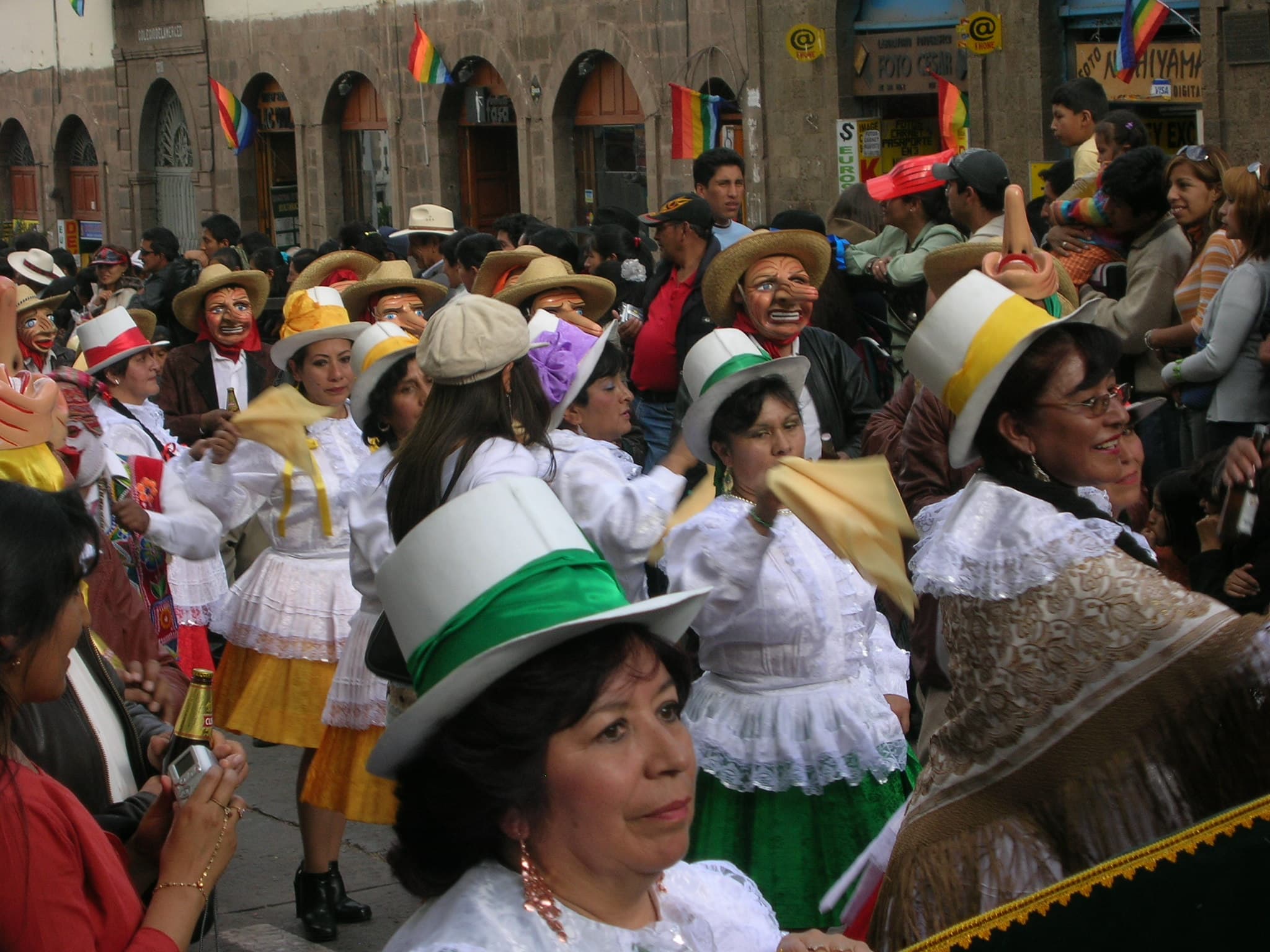
No Andean celebration in Arequipa makes sense without communal food and drink. The star is chicha de guiñapo, the beer of germinated purple maize fermented in the valley's own picanterías, which flows generously on these dates; before drinking, custom demands spilling a splash on the ground for Pachamama: the tinka, the first sip always belongs to the earth. Festival food revolves around the pachamanca, the method of cooking underground with hot stones: meats, potatoes, broad beans, and sweet potatoes wrapped in leaves and buried for hours until they emerge smoky and tender. Around it, the dance: in many valley communities and in the neighbouring Colca the emblematic dance is the wititi, declared Intangible Cultural Heritage of Humanity, in which men dance dressed in colourful skirts, a tradition tied to courtship and to the memory of the Collagua and Cabana peoples.
Where to Experience It and How to Approach with Respect
For the visitor who wants to approach this Andean Arequipa, the key window is the week of 21 to 24 June, but expressions of this heritage appear all year: in the Sunday fairs of the traditional towns, in the picanterías where chicha and the offering to the earth remain part of daily life, and in museums such as the Museo Santuarios Andinos of the UCSM, which holds Juanita, the girl offered on the Ampato volcano more than five centuries ago, the most eloquent proof of how deep the bond runs between this people and its mountains. The rule for approaching is simple: this is a ceremony, not a show. You may photograph discreetly, but it is best to ask first, especially during the offering; you do not interrupt the Andean master; and if you are handed a glass of chicha, accepting it, and spilling the first splash to the earth, is the best way to enter the festival rather than watch it from outside.
喜欢这个故事吗?
分享给喜爱阿雷基帕的人。
你有自己关于阿雷基帕的故事吗?
投稿文章 →