The Casa del Moral: A Journey Through Time in Arequipa's Baroque Heart
In Arequipa's historic center, Casa del Moral holds three centuries of history within its white sillar walls. Its mestizo Baroque doorway, hand-carved with Andean and European motifs, is considered one of Peru's finest.
Some buildings are not merely visited, they are inhabited by the imagination. Casa del Moral, at Calle Moral 318 in Arequipa's historic center, is one of them. The moment you turn the corner and see its white sillar facade gleaming under the Andean sun, something shifts in your pace. This is no ordinary museum. It is an 18th-century mansion that has survived earthquakes, wars of independence, the Republic, and mass tourism, and still holds the dense silence that only places which have witnessed much can carry.
Arequipa's Most Remarkable Doorway
The mestizo Baroque doorway of Casa del Moral is, for many historians, the most elaborate in the entire city. It was carved from white volcanic sillar stone in the early 18th century by craftsmen whose identities have been lost to time, but whose skill speaks for itself. The central arch concentrates an explosion of motifs: mermaids holding shields, rearing lions, grape clusters, and Andean pumas interlaced with European Baroque flowers. This is not mere decoration, it is a cultural manifesto.
The family crest of the mansion's original commissioner remains visible near the top. What is known for certain is that a high-ranking Spanish nobleman had it built in the early 1700s, and that the moral tree, a mulberry, that once shaded the inner courtyard gave the place its name. The tree is long gone, but the name outlived every one of its owners.
The doorway of Casa del Moral is not an ornament, it is a treatise on history carved in stone. Each figure tells something different about who we were and what we became.
Unlike Santa Catalina, which overwhelms through sheer scale, Casa del Moral impresses through concentration. Everything important is condensed into that facade and the interior courtyard. There is no need to walk kilometers or consult maps, you simply stop and look. The museum's guides, who speak Spanish and English, can point out details the untrained eye misses: the twin-headed serpent hidden among the flowers, the mascarons that seem to change expression with the light.
The Inner Courtyard and the Museum
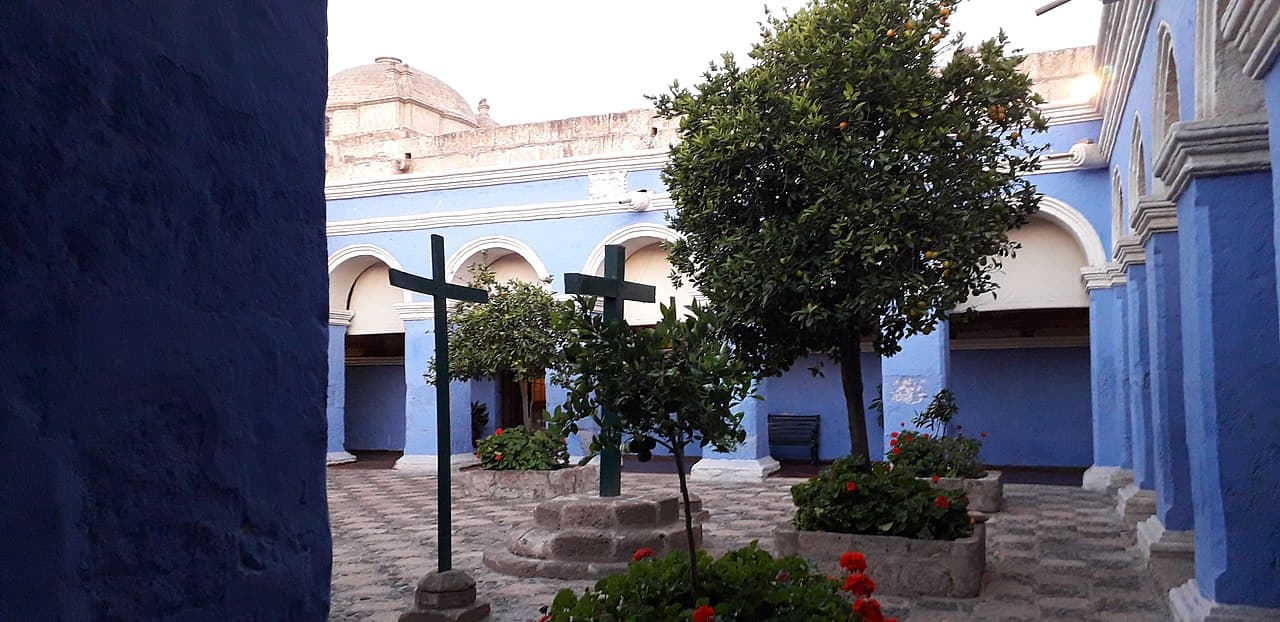
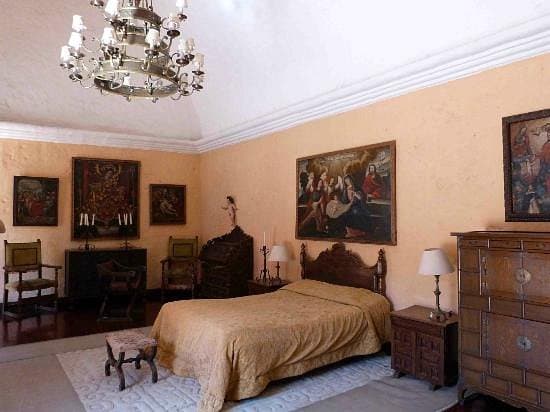
Once you cross the threshold, the noise of the street disappears. The inner courtyard of Casa del Moral has that singular stillness only well-preserved places possess, the silence is not emptiness, it is accumulation. A sillar fountain with a carved puma at its center anchors the space. Rounded arches frame the rooms that now serve as museum galleries, displaying colonial furniture, Cusco school paintings from the viceregal period, 18th-century Sevillian tiles, and a collection of domestic objects that reconstruct the daily life of Arequipa's colonial elite.
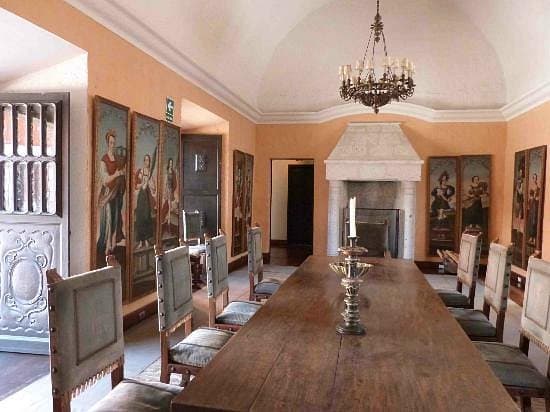
Casa del Moral today belongs to Banco Continental BBVA, which meticulously restored it in the late 20th century and opened it as a museum. Entry is affordable, under ten soles, and there is rarely a queue. It is one of the best-kept secrets in the historic center: while tourists line up outside the Monastery of Santa Catalina, here you can stand nearly alone before one of the continent's most important Baroque heritage sites. That alone is worth the detour.
Did you enjoy this story?
Share it with someone who loves Arequipa.
Have your own Arequipa story?
Submit an article →