Holy Week in Arequipa: Processions, Flower Carpets, and Sillar by Candlelight
When Holy Week arrives, Arequipa transforms without fanfare. The brotherhoods carry their floats through the historic center, residents cover the pavement with dyed flowers and sawdust, and the cathedral stays open from dawn. It is the city's most intense religious celebration — and few people outside Peru know it exists.
Holy Week in Arequipa does not compete with Ayacucho, Peru's most famous. It does not need to. It has its own processions, its own flower carpets, its own rhythm of a city that turns inward for seven days. For those who experience it from the inside — whether a lifelong Arequipeño or a visitor who arrived on the right date — it is one of the densest and most silent experiences the city offers. Dense because of the number of brotherhoods, the candlelit floats, the flower petals on the colonial cobblestones. Silent because, unlike Carnival, everything happens at night or in the early morning hours, with candles rather than loudspeakers.
The Procession of the Señor de la Agonía: Good Friday in the historic center
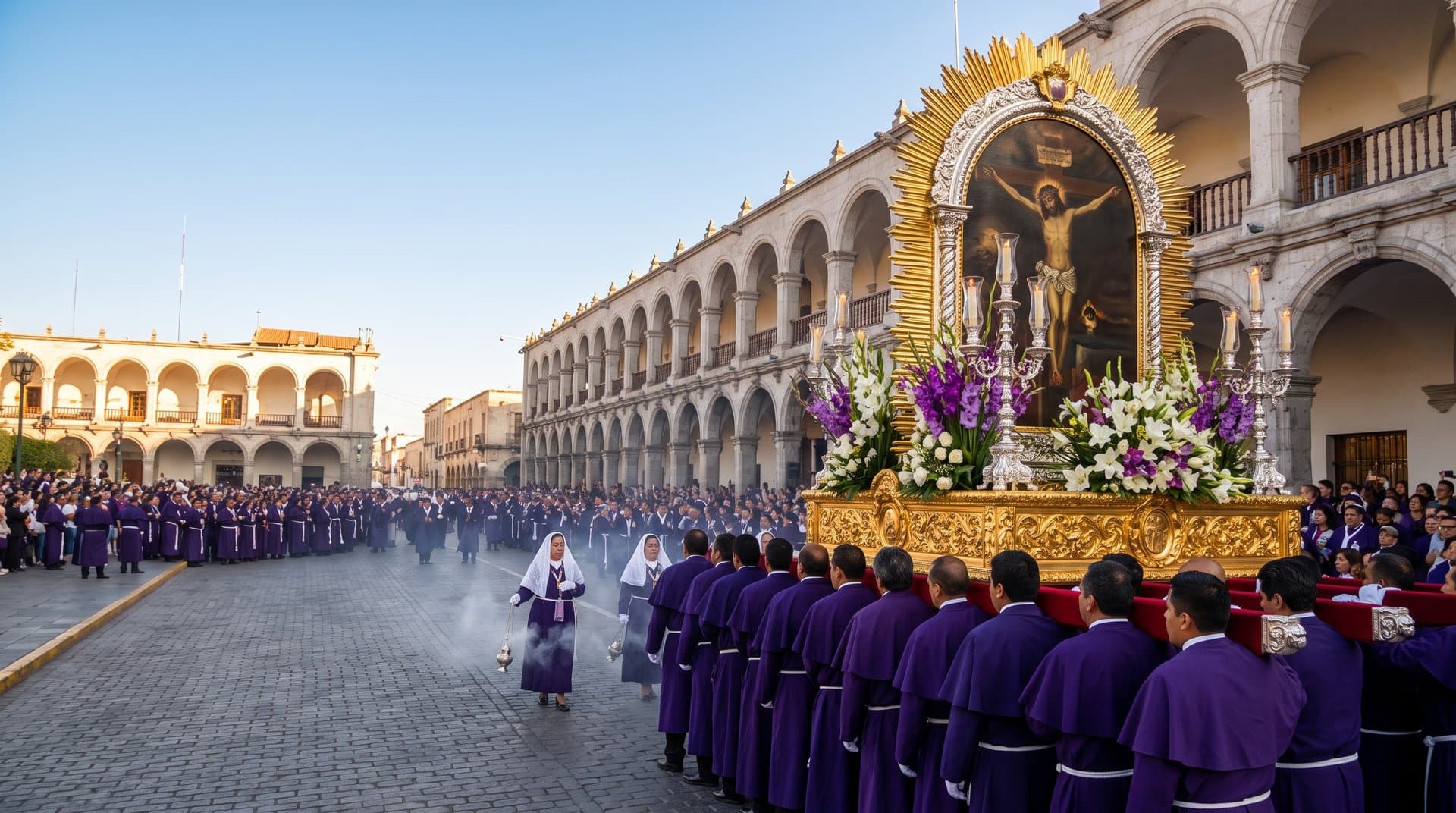
The most important procession of Arequipa's Holy Week is that of the Señor de la Agonía, which departs every Good Friday at 8:00 p.m. from the Church of La Merced on Calle Merced 303. The image — a 17th-century carving in cedar wood with original polychrome paint, realistic in a way that unsettles and moves in equal measure — is carried on a float by the brothers of the Brotherhood of the Señor de la Agonía, founded in 1632. The route follows a path unchanged for centuries: it climbs up Mercaderes, turns onto Calle Santa Catalina, passes in front of the facade of the convent of the same name, continues along Álvarez Thomas, and returns to La Merced via Calle Piérola. The entire route takes approximately two and a half hours.
The cofrades wear purple tunics, and those who accompany the procession carry candles sold in shops around the church from Holy Wednesday onward at S/ 3 or S/ 4 each. Brass and drum bands position themselves at the corners of the route and play processional marches that fill the space between the sillar buildings. The balconies of the historic center, which remain closed for most of the year, open during the procession and shower the image and the brothers with petals of roses and carnations from above. The combination of viceregal architecture lit by candlelight, the smell of wax and incense, and the processional music echoing through streets cleared of cars creates an atmosphere with no equivalent elsewhere in the city.
In Arequipa, Holy Week is the moment the city remembers that it built its churches in stone not only to last, but to matter.
The flower carpets: a neighborhood tradition
On Holy Thursday night, the families who live along the procession route come out to build carpets on the cobblestones. This is not a practice organized by the municipality or promoted by tourism agencies: it is a neighborhood custom that reproduces itself through imitation and family pride. The carpets combine petals of roses, carnations, and daisies with brightly dyed sawdust, colored sand, and in the most elaborate cases, woven palm leaves. The most detailed ones, like those that appear in front of the Church of San Francisco in the Plazuela San Francisco, reproduce biblical scenes with a precision that requires hours of collective work. Tradition held that they remain intact until the procession passed over them — part of their meaning is being walked upon and unmade beneath the weight of the image.
To see the carpets at their most elaborate, pass through the streets of the historic center between 10:00 p.m. and midnight on Holy Thursday, when the neighbors are still working on them under the glow of the streetlamps. Calle Álvarez Thomas, Calle Santa Catalina between the Plaza Regocijo and the convent, and the portal of the cathedral tend to have the most detailed carpets. There is no entrance fee or roped-off zone: this is ephemeral street art in the open, free and accessible to anyone who arrives at the right hour.
The foods of Arequipa's Holy Week
Arequipa's Holy Week has its own cuisine. Good Friday tradition requires abstaining from meat, and the picanterías adapt their menus to chupe de viernes: a thick soup of potatoes, hard-boiled egg, fresh cheese, milk, and ají colorado with no meat whatsoever. It is one of the oldest dishes in the city's cooking tradition and virtually impossible to find outside of this week. Buñuelos de viento — fried dough balls dusted with sugar and drizzled with chancaca honey syrup — are sold from street stalls in the historic center from Holy Wednesday onward, between S/ 1 and S/ 2 each. In Arequipeño homes, mazamorra morada and colación — a peanut sweet covered in colored sugar that appears only at this time of year — complete the table for the week.
Arequipa's Holy Week is not designed for tourists, and that is part of its appeal. There are no paid grandstands or special photography zones along the procession route. There are no guides with colorful umbrellas leading groups through the route. There are Arequipeños on the sidewalk who have spent decades watching the same image pass down the same street, and who tonight have brought a folding chair and a candle. Standing among them, without quite knowing what comes next, is probably the most honest way to understand what this week means to the city.
喜欢这个故事吗?
分享给喜爱阿雷基帕的人。
你有自己关于阿雷基帕的故事吗?
投稿文章 →