The Sabandía Mill: The Last Colonial Mill Still Grinding Grain
Eight kilometers from downtown, a 1621 sillar mill still grinds wheat between pre-Hispanic terraces and reed wetlands. How to get there, what it costs, and why it's worth the morning.
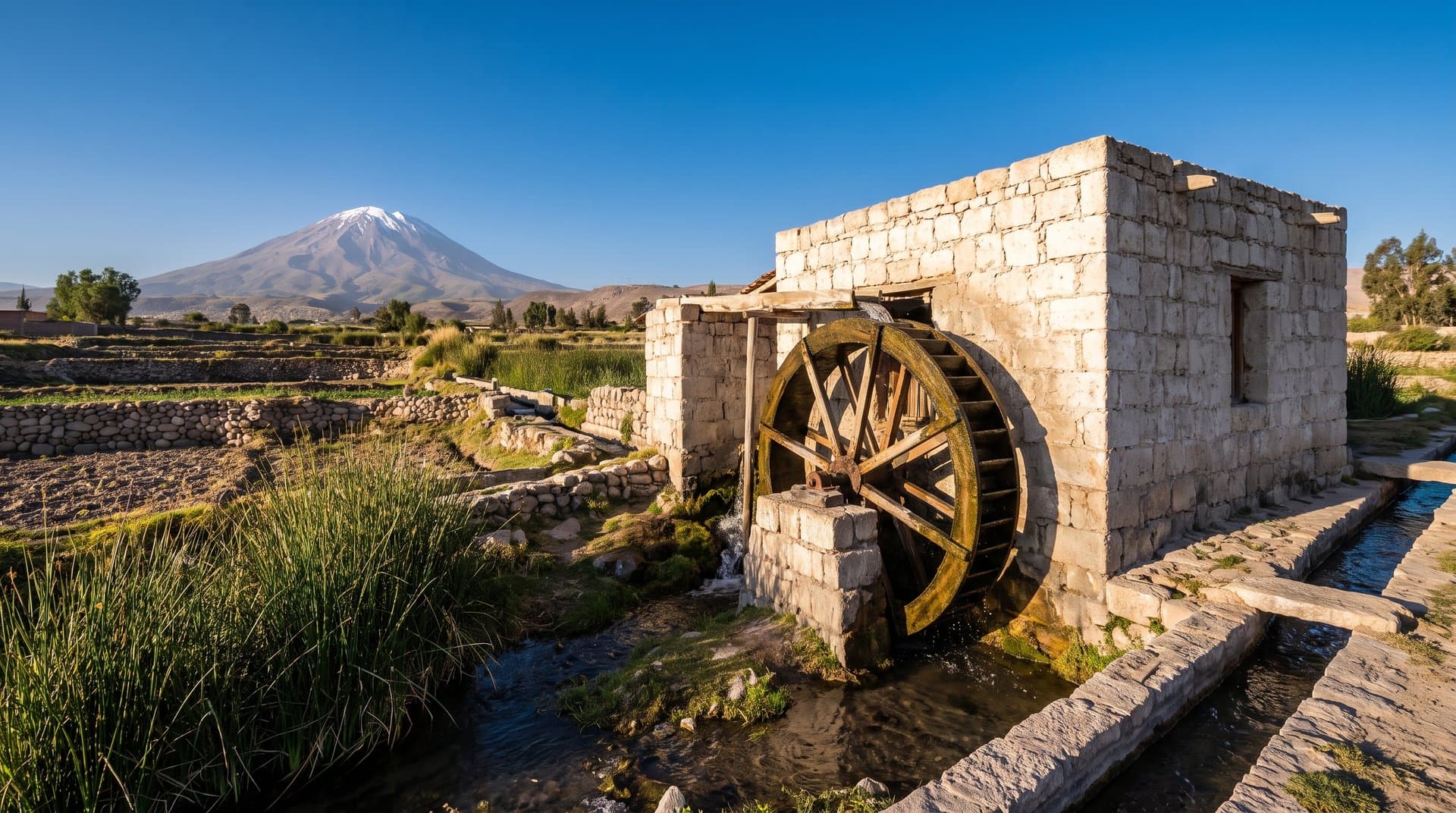
In the district of Sabandía, about eight kilometers southeast of downtown Arequipa, a sillar stone mill has been doing the same job for more than 400 years: grinding grain with water power flowing down from the Chili river. It is not a reconstruction or a tourist mock-up. The Sabandía Mill is, according to Peru's Ministry of Culture, the only colonial mill in the country that still has its original machinery running.
A four-century history
Spaniard Pedro Fernández Zambrano built it in 1621 on land that had been pre-Inca agricultural terraces worked by the people of Sabandía. Through the colonial era and much of the republican period it ground wheat from the surrounding valleys; its grinding stone, over a ton, is still the original one. It fell into disrepair by the mid-20th century until Arequipa architect Luis Felipe Calle Benavides restored it in 1973, bringing back its mojinete roof and water wheel to working order. It is now a National Historic Monument.
What surprises visitors isn't just the machinery but the setting: the mill sits among stone terraces still under cultivation, reed wetlands where wild ducks and cuculí doves nest, and water channels fed directly from the Socabaya river. The background noise isn't traffic, it's water falling onto the wooden wheel.
Getting there and what it costs
The simplest option from downtown is an app-based taxi, roughly 20 to 25 minutes and S/15 to S/20 depending on traffic. By combi, catch a route toward Sabandía from the Paucarpata or Jorge Chávez area and walk the last ten minutes from the town plaza; it costs under S/3 but takes about twice as long. Admission runs around S/10 for adults and S/5 for students with a valid ID, open daily from 9:00 a.m. to 5:00 p.m. Weekday mornings are best; weekends bring school groups and the courtyard fills up.
We're not selling a museum behind glass, we're selling a machine that still works. When there isn't enough water in the channel, it simply doesn't grind that day, same as four hundred years ago.
What else to see in Sabandía
A fifteen-minute walk away is the Mansión del Fundador, a colonial house that belonged to Garci Manuel de Carbajal, the Spanish founder of Arequipa, now a museum with period furniture and a private chapel. Several country restaurants around Sabandía's plaza serve rocoto relleno and chicharrón on weekends, with tables under grapevines and volcano views on the clear mornings that southern-hemisphere winter tends to deliver.
It's a half-day trip, not a full-day one, which is exactly why it rarely makes it onto packaged itineraries: no booking required, no guide to arrange in advance, and it fits between a late breakfast and lunch back in the city.
Did you enjoy this story?
Share it with someone who loves Arequipa.
Have your own Arequipa story?
Submit an article →