Santa Catalina: The City Within the City
For three hundred and seventy-two years, the Monastery of Santa Catalina de Siena operated as a sealed city where Dominican nuns lived, cooked, prayed, and died without ever leaving. Its alleys painted in red and indigo, its silent cloisters, and its cells transformed into private apartments are today the best-preserved colonial complex in Peru.
The Monastery of Santa Catalina de Siena in Arequipa opened its doors to the public for the first time on 6 August 1970, four centuries after its founding in 1579. For all that time, its sillar-stone walls — over a metre thick — enclosed a community that at its eighteenth-century peak numbered 450 people: some 150 Dominican nuns plus servants, novices, donadas, and enslaved Black women who worked in the orchards and kitchens. The city they inhabited has its own streets — Calle Sevilla, Calle Córdoba, Calle Granada — named after the Spanish cities from which the wealthiest nuns' families came.
Foundation and the Commerce of Sainthood
The monastery was founded on 2 October 1579 by doña María de Guzmán, a wealthy Creole widow from Arequipa's elite, under licence from King Philip II. From the outset it functioned as a destination for the second daughters of prosperous families who could not afford a full marriage dowry: entry to Santa Catalina cost between 1,000 and 2,500 silver pesos depending on the novice's rank, a sum equivalent to several thousand dollars today. In return, the family received the spiritual privilege of having a "bride of Christ" among its members, considered a guarantee of divine blessing. The cells of the wealthiest nuns — some with a sitting room, private kitchen, private garden, and even personal servants — were passed from mothers to daughters within the monastery, becoming small inherited properties.
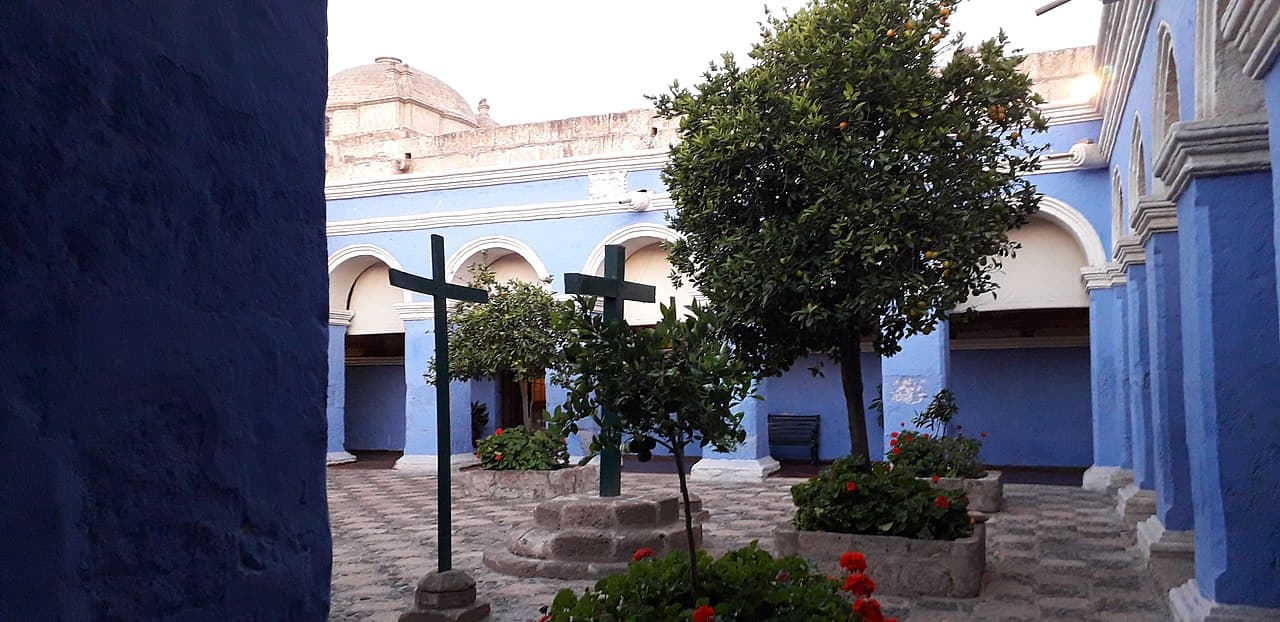
Calle Sevilla, the most photographed corridor in the complex today, was in the seventeenth century the passage for the highest-ranking nuns: its walls painted Pompeian red — an expensive pigment in colonial times — signalled the status of those whose cells opened onto it. Calle Córdoba, its walls indigo blue, housed nuns of middling rank. The colour distinction was written into no official regulation; it was a tacit social convention that no one questioned for centuries.
Santa Catalina was not a place to flee the world — it was a world in miniature, with its own hierarchies, its own conflicts, and its own luxury.
Sister Ana de los Ángeles and the Nineteenth-Century Reform
In 1871, Mother Superior Josefa Cadena imposed the strict enclosure rule the monastery had flouted for centuries: no secular servants, no private property inside the cells, no free communication with the outside. The reform reduced the community from over 300 people to fewer than 40 nuns who accepted the new discipline. The rest left. The monastery we know today — ordered, silent, museum-like — is the product of that belated reform. Before it, according to Archdiocese records, it was "more like a palace divided into apartments than a house of prayer." The most venerated historical figure in the monastery is Sister Ana de los Ángeles Monteagudo (1602–1686), beatified by John Paul II in 1985 and canonised as patron of Arequipa in 2024, whose original cell in the orange-tree cloister can be visited with a guide.
Visiting the Monastery Today: Prices and Strategy
Entry costs S/ 45 for foreign visitors and S/ 25 for Peruvian nationals (2025 rates). Opening hours are 9:00 to 17:00 daily, with the ticket window closing at 16:00. The complex covers 20,000 square metres — nearly three hectares — and seeing it properly takes between 2.5 and 3.5 hours. On Tuesday and Thursday afternoons, between 14:00 and 17:00, the seventeen Dominican nuns who still reside in the cloistered section of the monastery celebrate vespers, and it is possible to hear Gregorian chant from the main courtyard at no extra cost. The best strategy is to arrive when it opens at 9:00, before the guided tour groups that arrive around 10:30. The official monastery guide charges an additional S/ 40, but the self-guided visit with the leaflet given at the ticket window is sufficient to understand the historical context.
喜欢这个故事吗?
分享给喜爱阿雷基帕的人。
你有自己关于阿雷基帕的故事吗?
投稿文章 →