The Valley of the Volcanoes: Andagua's Eighty Cinder Cones Few Travelers Ever See
Several hours from the city, in Castilla province, a valley holds more than eighty small volcanic cones scattered across a desert of dark stone. How to get there, when to go, and why most visitors pair it with Cotahuasi Canyon.
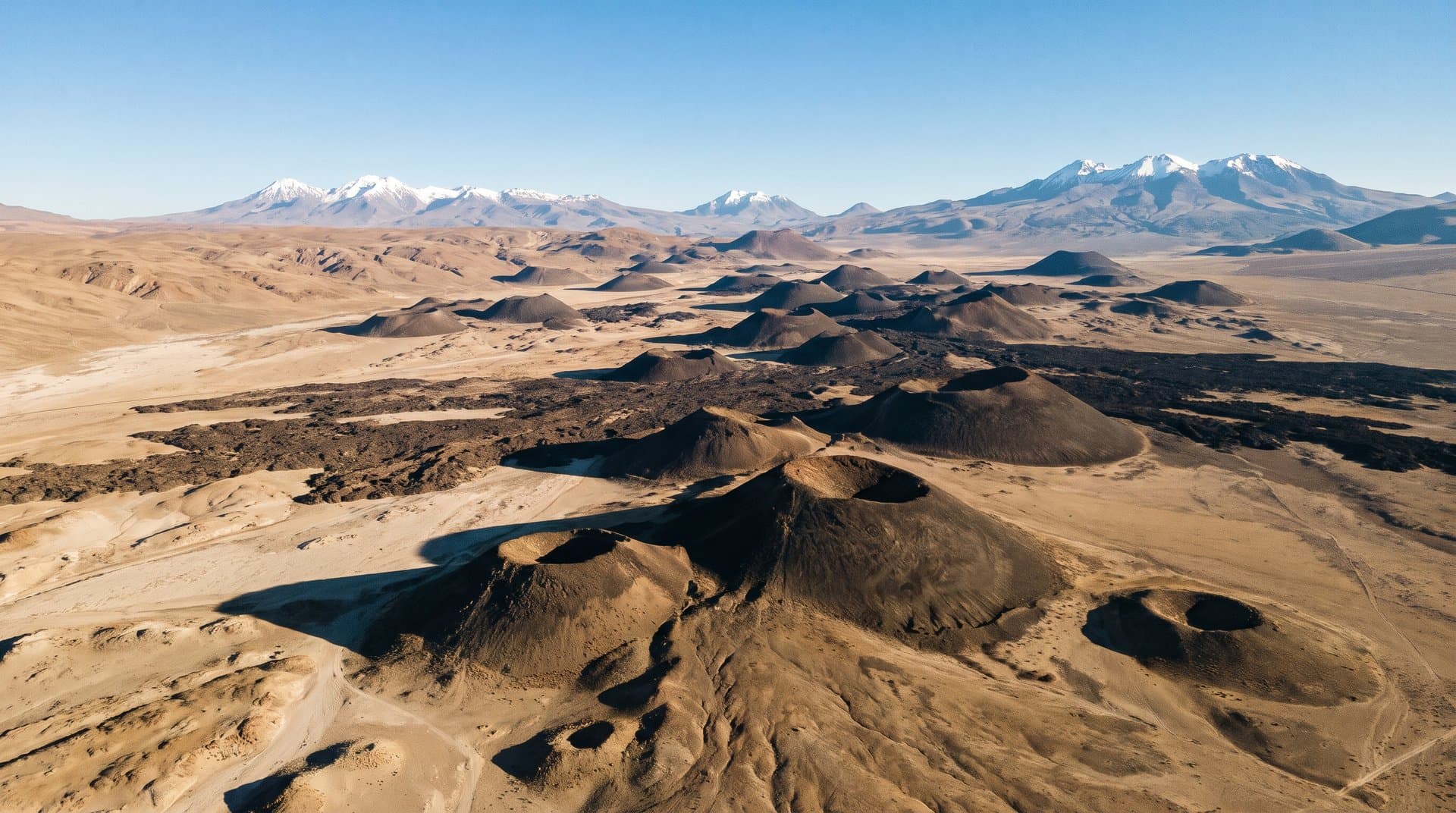
Four or five hours before arriving, the landscape already shifts: the road climbing out of Cotahuasi Canyon leaves the farmland behind and enters a desert of volcanic rock where, suddenly, dozens of dark cones appear lined up against the valley's pale floor. This is the Valley of the Volcanoes of Andagua, in Castilla province, several hours from the city of Arequipa.
More than eighty cones in a valley formed fairly recently
The valley holds more than eighty small cinder-cone volcanoes, the product of eruptions that are recent by geological standards: dark lava flows that still stand out sharply against the surrounding terrain, without the thousands of years of erosion that soften other volcanic landscapes in the Andes. Walking among them feels less like touring a geological ruin and more like standing on a landscape that only recently finished taking shape.
Andagua, the town that lives between farm plots and craters
The town of Andagua, capital of the district of the same name, holds the basic services for visiting the valley: simple guesthouses, a couple of restaurants serving home-style food, and a main square with a colonial church built from dark volcanic stone, a sharp contrast with the white sillar that defines the city of Arequipa. Around it, terraced plots of potato, quinoa, and fava beans share the land with grazing llamas and alpacas, the economic backbone of the area long before tourism arrived.
From the Soporo viewpoint, a short walk from town, the whole valley comes into view: dozens of dark cones scattered across a pale floor, as if the desert itself had broken out in bubbles.
The most common approach is to pair the Valley of the Volcanoes with a two- or three-day circuit that includes Cotahuasi Canyon, one of the deepest in Peru. The road connecting the two destinations is largely unpaved, so most travelers hire a 4x4 or join an organized tour out of Arequipa rather than attempt the route in a regular car.
The dry season, from April through November, is the best time to go: rains in the southern highlands make the dirt stretches harder to pass between December and March. At over 3,600 meters above sea level, nights stay cold even in the dry months, so it's worth packing warm layers, cash in soles (ATMs don't reach Andagua), and, if possible, an extra day of buffer in case the road gets rough.
Vous avez aimé cette histoire ?
Partagez-la avec quelqu'un qui aime Arequipa.
Vous avez votre propre histoire sur Arequipa ?
Soumettre un article →