Toro Muerto: South America's Largest Petroglyph Field
Three hours from Arequipa, thousands of centuries-old carvings cover a desert of volcanic rock. A practical guide to visiting Toro Muerto: how to get there, when to go, and what to bring.
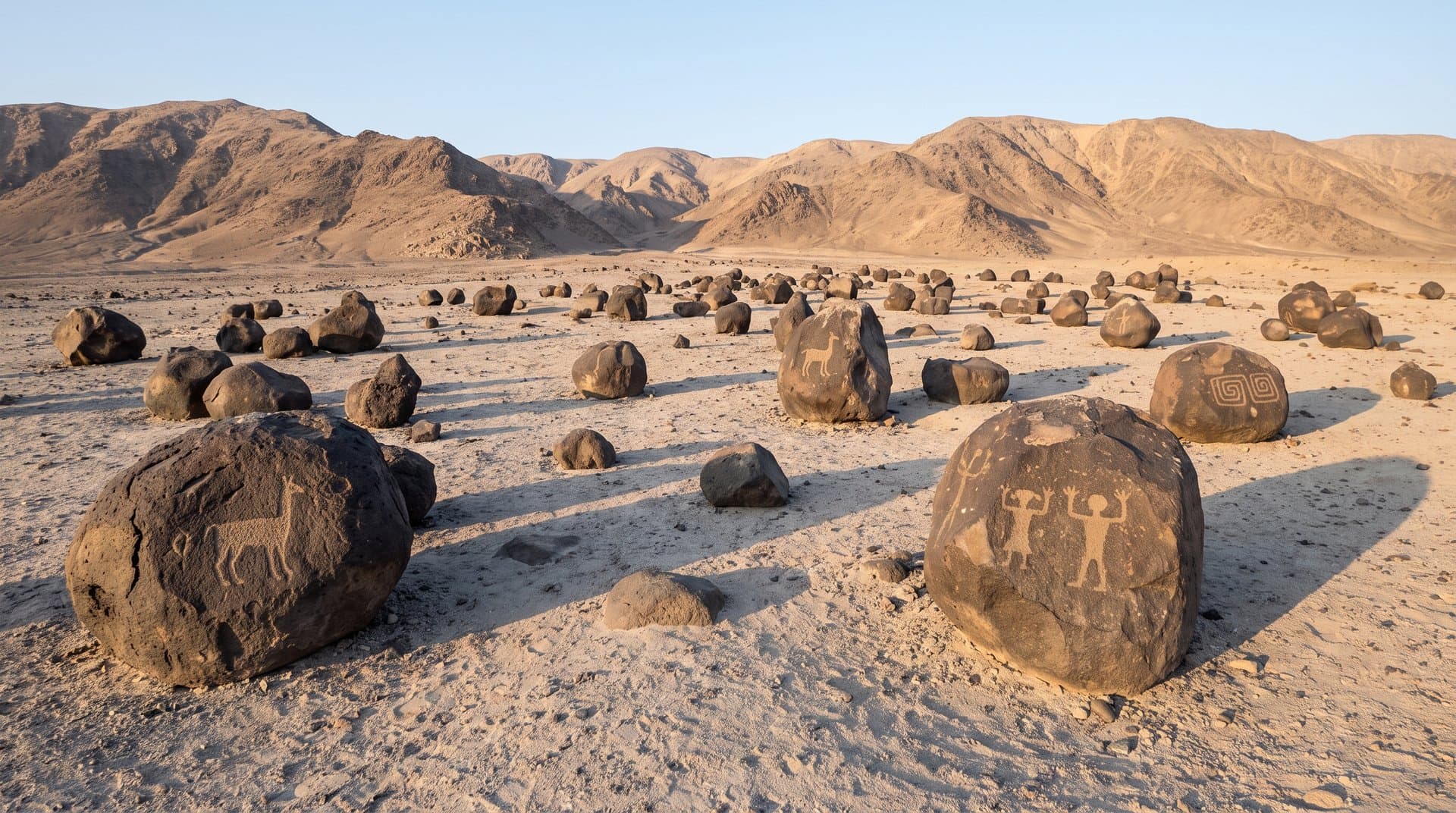
In the district of Corire, in Castilla province, a desert scattered with volcanic boulders holds one of the most extensive collections of rock art on the continent. It is called Toro Muerto, and archaeologists have been studying it for more than seven decades without exhausting what it has to tell.
Thousands of figures carved into volcanic rock
The site stretches across several kilometers of an ancient volcanic tuff flow: pale boulders that time and oxidation darkened on the surface. By scraping away that dark patina with a harder stone, the original artists left light figures against a dark background: llamas and alpacas in rows, dancers wearing headdresses, birds, felines, and geometric motifs. Researchers have catalogued thousands of engravings, with counts ranging from roughly 3,000 to more than 5,000 carved stones depending on the survey and the area included, making Toro Muerto one of the largest petroglyph fields in the Americas.
Arequipan archaeologist Eloy Linares Málaga began systematically documenting the site in 1951 and spent much of his career cataloguing it. Dating remains debated: some carvings are linked by researchers to Wari influence, roughly between the 8th and 12th centuries, while others may be earlier or later, etched by different generations onto the same stones.
There is no marked path between the stones, the guide in Corire told me. Every visitor finds their own figures, and there is always one the previous group missed.
How to get there and what to bring
Shared vans leave Arequipa's Terminal Terrestre for Corire and Aplao along the Panamericana Sur, a roughly three-hour drive covering about 160 kilometers. Arequipa tour agencies also run it as a day trip, usually combined with the town of Corire and its citrus orchards along the Majes river. From town, a short moto-taxi ride covers the final stretch to the site entrance.
The municipality charges a small entrance fee and the Ministry of Culture staffs an access control point, but there is no shade, no restrooms, and no food stalls inside the petroglyph field itself. A hat, sunscreen, water, and closed shoes for walking over sand and loose rock are essential. Arrive early, before nine in the morning, while the desert sun is still bearable; October, within the dry season, is one of the better months to go.
Travelers with more than a day to spare can continue north to the Valle de los Volcanes near Andahua, several hours further on, where dozens of small volcanic cones line up across the same desert landscape that begins at Toro Muerto.
Vous avez aimé cette histoire ?
Partagez-la avec quelqu'un qui aime Arequipa.
Vous avez votre propre histoire sur Arequipa ?
Soumettre un article →