Christmas and New Year in Arequipa: Traditions, Food and Practical Tips
How the holidays are lived in the White City: Christmas Eve, panettone and hot chocolate, a lit-up Plaza de Armas, chocolatadas, New Year superstitions and what to expect as an outsider.
December in Arequipa looks nothing like the snowy Christmas cards. It is sunny by day, the dry high-altitude air cools off as soon as evening falls, and the holidays are lived at the table, in the plaza and in the street more than behind shop windows. If you are spending them in the White City, here is a practical guide to what really happens.
Christmas Eve: a late dinner and a midnight toast
The big celebration is the night of December 24. Families sit down to a late dinner and wait for midnight to toast, hug and open presents. In many homes the centerpiece is roast turkey or suckling pig, served with apple salad and mashed potatoes, and in Arequipa it is not unusual to find something local on the table too, such as adobo or stuffed rocoto pepper.
The toast is hot chocolate with panettone. Panettone, the sweet bread with candied fruit, reaches every supermarket from November and is given in boxes and gift baskets. Prices vary a lot by brand and size, so compare before buying on the eve, when everything goes up.
Plaza de Armas, nativity scenes and lights
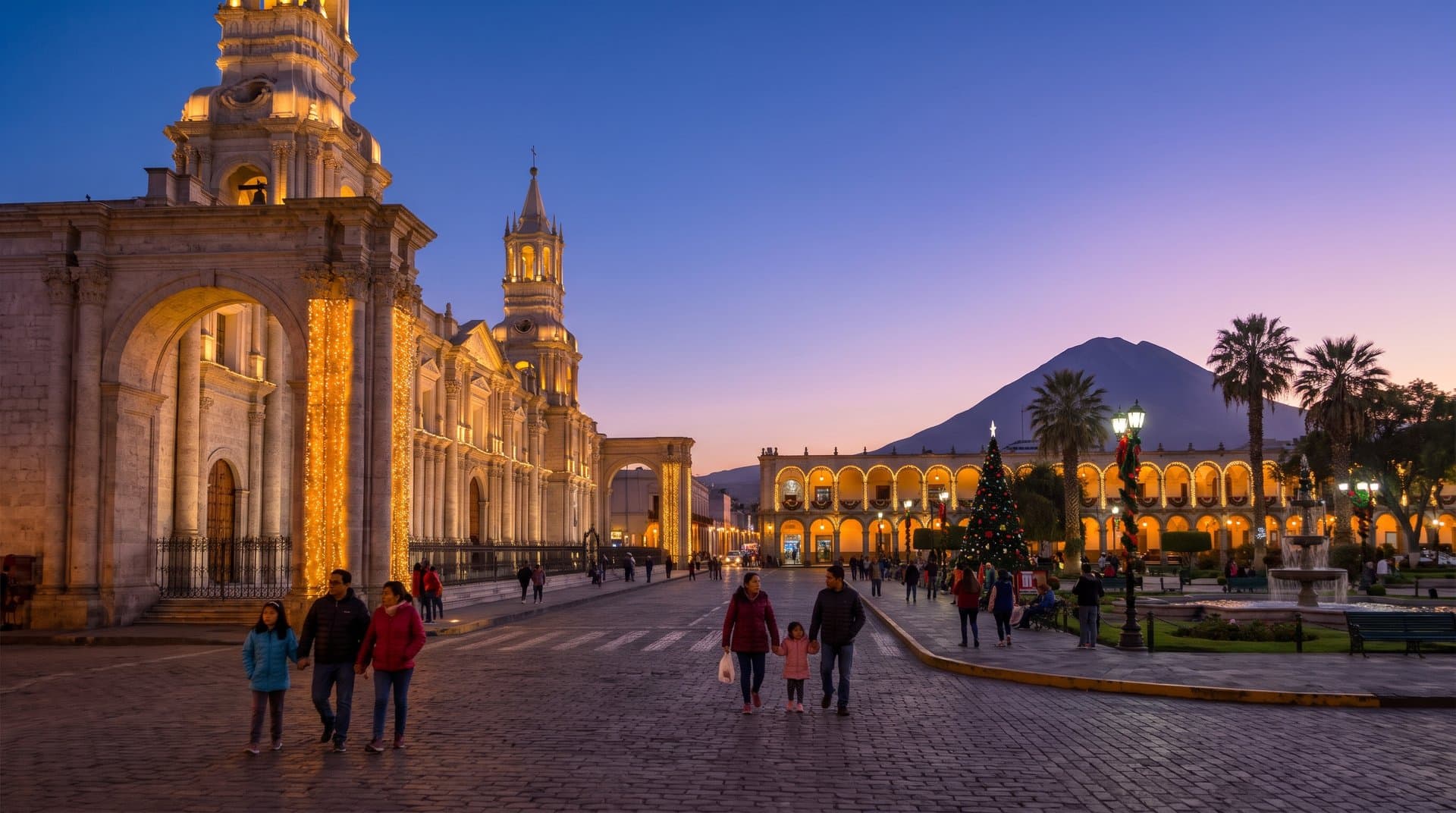
In December the historic center lights up. Decorations and lights go up around the Plaza de Armas and under the arches of the portals, and churches set out their nativity scenes. It is worth walking the plaza at night with the cathedral behind you: the white sillar stone takes on a warm tone under the lighting and, on a clear night, Misti stands out behind it.
A useful tip: on the afternoon of the 24th shops close early and public transport empties out suddenly. If you need something, buy it ahead of time and do not leave the ride home for the last minute.
In Arequipa, Christmas is measured in after-dinner conversation: whoever leaves the table early misses half the party.
Chocolatadas and neighborhood Christmas
A very Peruvian custom that you also see here is the chocolatada: a neighborhood, school or parish gathering where hot chocolate and panettone are handed out to children, especially in the city's more working-class districts. If you come across one as a visitor, it is a good window into local life; if you want to help, the normal thing is to ask the organizer what is needed before bringing anything.
New Year's Eve: yellow, suitcases and grapes
December 31 brings superstitions shared across Peru. Many people wear new yellow underwear for good luck, some walk around the block with a suitcase to call in travel for the coming year, and others eat twelve grapes, one for each wish. At midnight there are hugs, toasts with champagne or cider, and fireworks you can hear from the higher districts.
If you have pets, remember that firecrackers frighten dogs and cats. Keeping them indoors with the window shut and a radio playing softly helps more than you would think.
Practical tips for expats and travelers
Book ahead if you are traveling: lodging, buses to Cusco, Lima or Puno, and flights fill up during the two holiday weeks. Pack a light but real jacket for the evenings, because at over 2,300 meters above sea level the temperature drops quickly after sunset, and December is already rainy season in the highlands, so some afternoons bring showers.
Also, not everything is open: on December 25 and January 1 many businesses close or run reduced hours. Some traditional picanterias open at midday on the 25th; call ahead to confirm. One more detail: keep cash in small soles bills, because change gets scarce on the busiest days.
How to join in as an outsider
The best thing you can do is accept an invitation. If a neighbor, a coworker or your landlord invites you to dinner, go, and bring something simple to share, like a panettone, a bottle or a dessert. It is the fastest way to understand how a home in Arequipa celebrates and, besides, it is the custom: nobody arrives empty-handed.
喜欢这个故事吗?
分享给喜爱阿雷基帕的人。
你有自己关于阿雷基帕的故事吗?
投稿文章 →