Banking for Foreigners in Arequipa: Accounts, Yape, and Why Cash Still Rules
Which bank makes sense to open, what each one asks for depending on whether you hold a carné de extranjería or just a passport, why everyone uses Yape, and where to change dollars downtown without losing on the exchange rate.
The first administrative stumble for almost any foreigner staying in Arequipa more than a few weeks is not the rental contract or the immigration paperwork: it is realizing you cannot pay the way you pay at home. Foreign credit cards work at supermarkets and some restaurants downtown, but the market, the combi, the taxi, and the neighborhood picantería only understand cash soles. And opening a local account turns out easier or harder depending on a single document: the carné de extranjería.
Which bank actually makes sense
The five banks with the heaviest presence in Arequipa are BCP, BBVA, Interbank, Scotiabank, and the state-owned Banco de la Nación, which almost no one uses outside of government paperwork. BanBif and Banco Pichincha round out the list, with fewer branches but shorter lines. To open a full savings account, all of them ask for a valid carné de extranjería, the ID card Migraciones issues after a residence visa; a stamped tourist passport is not enough. Someone entering on a tourist visa can still operate simplified low-balance accounts that BCP and Interbank offer from the phone with just a passport, but those cap how much money can come in or go out per month.
The branches foreigners actually use are not scattered around the city: they cluster on Calle Mercaderes and around the Portal of the Plaza de Armas, where BCP, BBVA, and Interbank have agencies a few meters apart. Newer branches with shorter lines sit inside Mall Aventura Plaza and Parque Lambramani, in Paucarpata and Cayma respectively, useful for dodging the month-end payday crowds downtown.
Yape, Plin, and the cash that refuses to disappear
Since Peru's central bank forced interoperability between digital wallets in 2023, Yape (BCP's app) and Plin (the BBVA, Interbank, and Scotiabank consortium) now work across each other: a phone number on Yape can get paid without friction by someone who only has Plin. The result is that even a juice stand inside Mercado San Camilo or a shared taxi has a QR code taped to the windshield. The catch for a newcomer is that linking Yape or Plin requires an active Peruvian bank account, which loops back to the same wall: no carné de extranjería, no account, no digital wallet either.
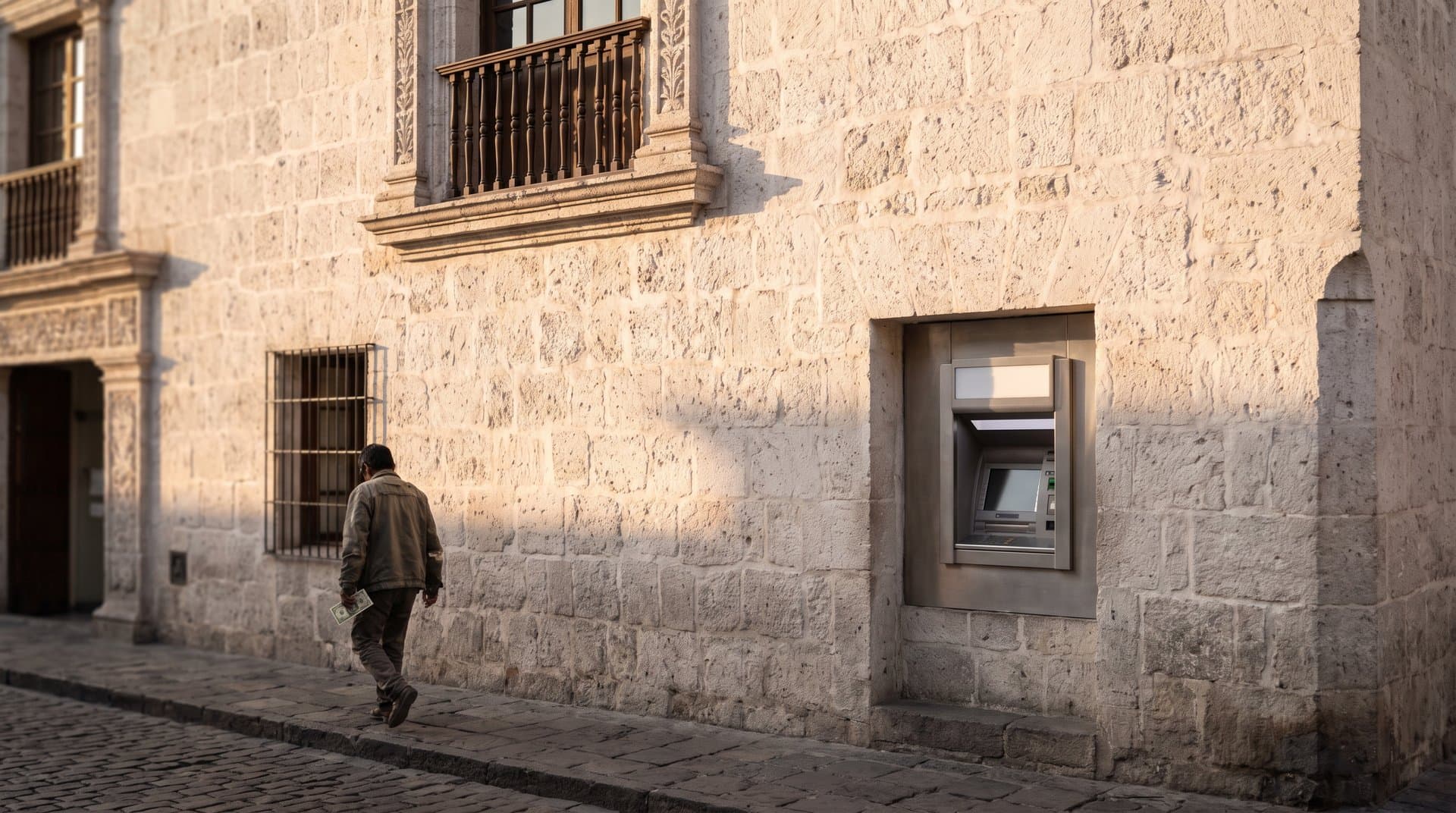
For the first three months I kept pulling cash from the airport ATM like I was still living in Europe. Once I finally got my carné and opened an account at BCP, I understood why every market vendor prefers the QR code to a bill: nobody has to make change.
For anyone just passing through, the practical move is still carrying cash soles for daily life and saving the foreign card for supermarket chains like Plaza Vea or Metro and for hotels, where any surcharge for foreign cards, if it exists, is usually posted at the register.
Exchange houses: where to change dollars without losing on the rate
Foreign bank ATMs charge a flat withdrawal fee on top of whatever the home bank adds, so for larger amounts it pays to exchange cash dollars instead. Calle Jerusalén, two blocks from the Plaza de Armas, has concentrated the downtown exchange houses for decades, with rates that update several times a day and almost always beat the banks. The standard advice from locals is simple: count the money right there before putting it away, and skip the street changers offering a slightly better rate outside an established storefront.
喜欢这个故事吗?
分享给喜爱阿雷基帕的人。
你有自己关于阿雷基帕的故事吗?
投稿文章 →