Arequipa's Queso Helado: The Battle for the Original Dessert
In Arequipa, asking which queso helado is the best can ruin a friendship or start an hour of passionate debate. This semi-frozen milk dessert, dusted with cinnamon and coconut, is the White City's sweet signature — and every ice cream shop swears they have the original.
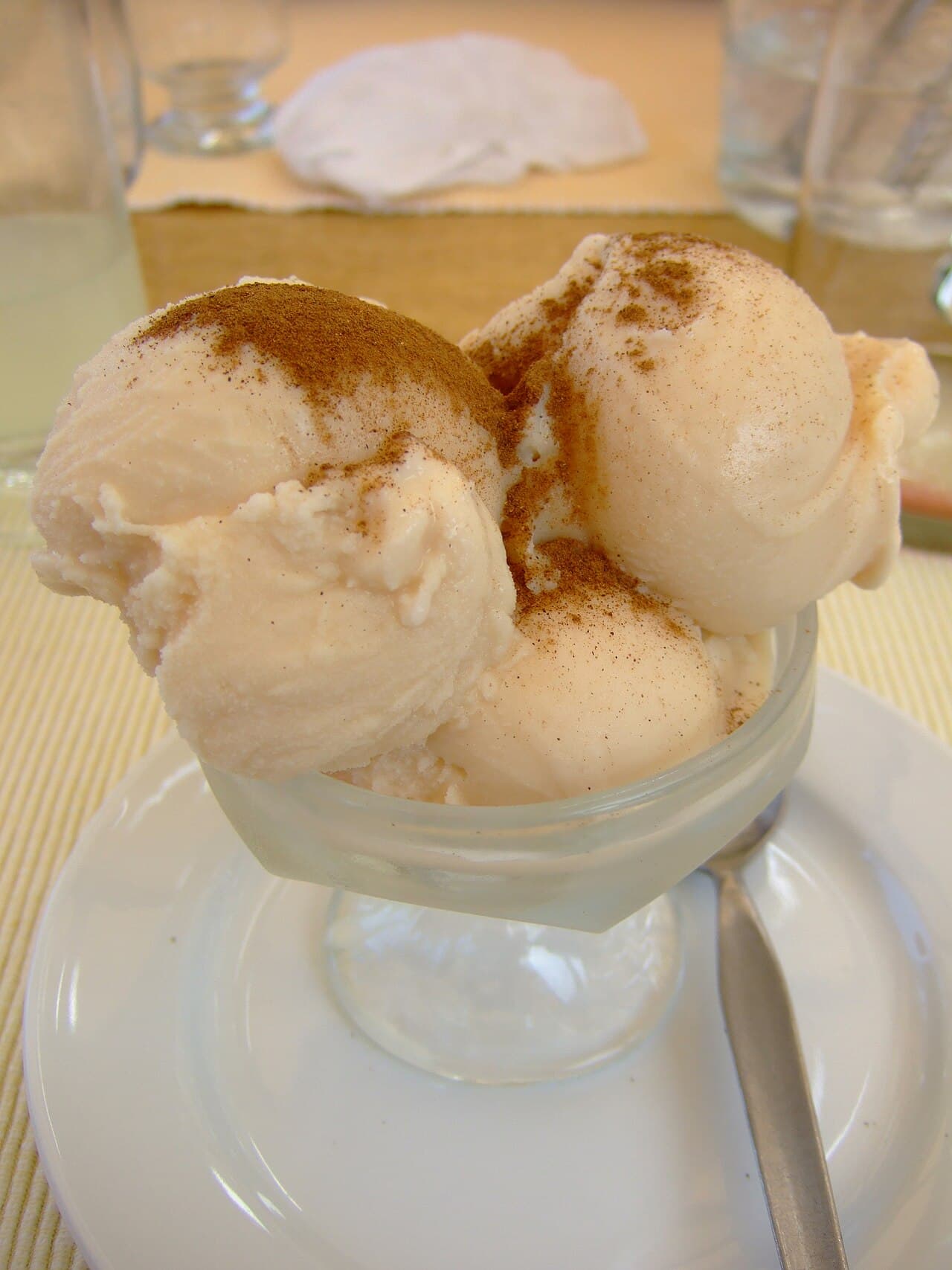
The first time someone puts a queso helado in front of you, the confusion is legitimate. It looks like a triangle of white cheese wrapped in wax paper, served on a small ceramic plate. But the moment you take the first bite — that texture halfway between ice cream and nougat, the flavor of slow-cooked milk with cinnamon, the touch of grated coconut and the vanilla note that rises at the end — you understand why Arequipa has spent centuries defending this dessert as its own.
Arequipa's queso helado is not cheese, and it is not exactly ice cream in the industrial sense either. It is a dessert unique in all of Peru, made with evaporated milk, fresh milk from the farms of Sachaca and Tiabaya, sugar, grated coconut, ground cinnamon, and a hint of clove. The mixture is cooked slowly over low heat, poured into rectangular molds, and frozen. When served, it is cut into triangles and dusted with more cinnamon. Tradition dictates it is accompanied by chancaca honey syrup.
A dessert with no equivalent in Peru
The exact origin of Arequipa's queso helado is a matter of academic debate. What is documented is that it appears in picantería recipe books from the White City since at least the 19th century, and that its preparation was in the hands of women who made it at home and sold it in the San Camilo and La Palza markets. Unlike industrial ice cream, which uses stabilizers and is served at below-freezing temperatures, queso helado is served semi-frozen — somewhere between firm gelatin and soft nougat.
The secret of good queso helado is in the milk. The best ice cream shops in Arequipa still use fresh milk from the districts of Sachaca, Tiabaya, and Uchumayo, where cows graze in the countryside just a few kilometers from the historic center. That milk has a fat concentration that pasteurized supermarket milk cannot replicate. The result, when handled well, is a density and flavor that are recognizable from the very first bite and impossible to forget.
Queso helado is not a dessert. It is the signature of a city that knew how to turn something simple into something irreplaceable.
The ice cream shop war
In Arequipa, rivalry between ice cream shops is a local sport. Heladería Ibérica, on Calle Mercaderes 141 in the historic center, is the oldest and most cited in tourist guides — it has been operating from the same location for over eighty years. Their queso helado is more compact, less sweet, with a more pronounced coconut flavor. A few blocks away, Heladería El Turista defends a softer, creamier version that many Arequipeños prefer. The argument never gets resolved, and that is part of its charm.
Outside the historic center, Heladería El Chalán on Av. Parra 123 in Miraflores has its own devoted fans who claim that neighborhood queso helado beats the downtown version. It is worth making the pilgrimage and deciding for yourself. The price at all of them is similar: between S/ 3 and S/ 5 per individual portion. With chancaca honey included, naturally.
Queso helado at the picantería
The most Arequipeño place to eat queso helado is not an ice cream shop but at the end of a picantería lunch. At La Lucila in Sachaca, La Nueva Palomino in Vallecito, and El Tío Darío in Cayma, queso helado closes the menu after the main course with the same inevitability that coffee ends a European meal. It arrives without you ordering it, on the traditional ceramic plate, with a thread of chancaca honey syrup on top. At that moment, after the adobo and the chicha de guiñapo, it serves a specific function: cleansing the palate, cooling the heat from the rocoto pepper, and rounding off three hours of lunch with something cold, sweet, and light.
この記事はいかがでしたか?
アレキパが好きな人にシェアしてください。
アレキパに関する自分だけの物語がありますか?
記事を投稿する →