Soltero de Queso: The Cold Salad That Opens the Table at Any Arequipa Picantería
Fava beans, paria cheese, mountain corn and rocoto in a salad that never touches heat. Why it always arrives before the main dish, where its name comes from, and which picanterías in Yanahuara and Umacollo still make it the old way.
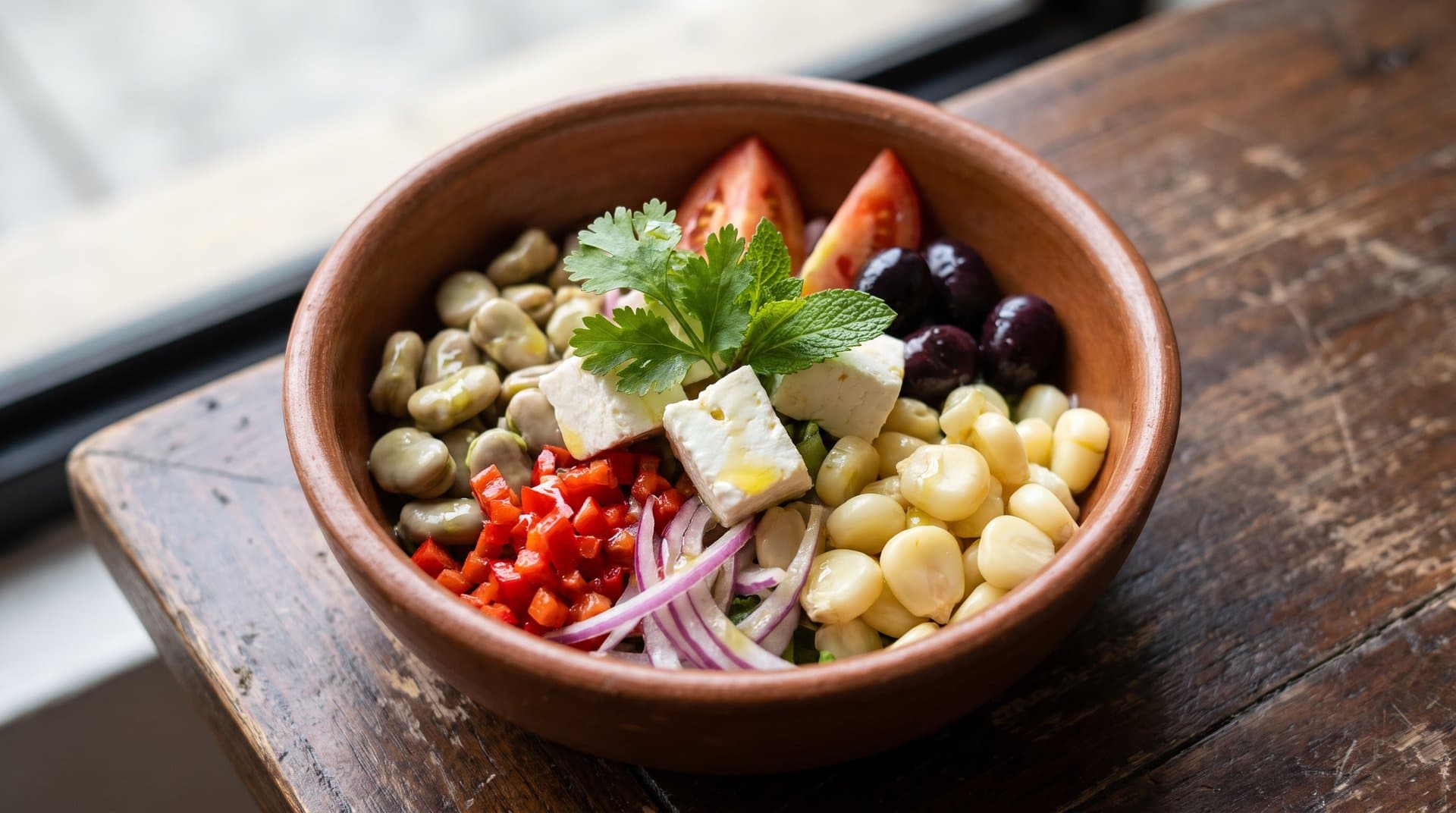
At an Arequipa picantería, the waiter almost never asks if you want a starter: it just arrives the moment you sit down, while you are still deciding between rocoto relleno and chupe de camarones. Nine times out of ten it is soltero de queso: peeled fava beans, mountain corn kernels, cubed paria cheese, finely chopped rocoto, red onion, botija olives and tomato slices, all dressed in an oil and vinegar vinaigrette with crushed huacatay. Nothing is cooked to order; it is served cold or at room temperature, straight from the pot it has rested in since morning.
Why it is called soltero (bachelor)
There is no birth certificate for the name, but the oldest picanteras in Yanahuara tell two versions, and neither has fully won out. The first says it was the dish a single man could put together without really knowing how to cook: peel beans, cut cheese, mix, no stove or anyone to make him something hot. The second, more tied to the countryside, says it was served to unmarried young men during farm work in Characato and Sabandía, a holding dish while the rest of the pot kept boiling. What is documented is that it appears in Arequipa recipe collections from at least the second half of the 20th century as a fixed picantería starter, not a recent restaurant invention.
Soltero does not compete with rocoto relleno or chupe de camarones. It is there so the table is not empty while the heavier dish finishes coming out of the kitchen.
Where the ingredients actually come from
The fava beans and corn in a proper soltero do not come from a supermarket bag: they come from the valleys ringing the city, mainly Characato, Sabandía and Yura, where the main harvest falls between April and June, though Mercado San Camilo stocks them nearly year round thanks to growers who stagger their planting. The cheese is paria or fresh cow cheese, firm and lightly salted, different from the softer cheese used in rocoto relleno; it is sold by the kilo at the dairy stalls inside San Camilo or straight from cheese makers in Characato and Yura.
Huacatay, an herb that looks like mint but tastes earthier, is what separates a properly made soltero from a generic one: crushed with a little garlic and oil, it scents the whole salad without taking it over. Without huacatay, the dish tastes like a plain fava bean salad. With it, it tastes like Arequipa.
Where to eat it the way it has been made for decades
La Nueva Palomino, at Leoncio Prado 345 in Umacollo, serves it as a complimentary starter with any main dish, as does La Benita, in the Jerusalén area of the historic center. In Yanahuara, Picantería La Capitalina still peels its fava beans by hand each morning, something not every picantería bothers with anymore. Ordered on its own rather than as a free starter, it runs between 15 and 22 soles depending on the spot, less than half the price of a full rocoto relleno.
It is eaten with a spoon, mixing a bit of everything into each bite: cheese, fava bean, corn, and that touch of rocoto that does not burn hard but makes itself known. It is probably the Arequipa dish fewest tourists know by name, and the one most locals order without a second thought, because to them it is not a restaurant dish. It is simply what shows up before the real meal does.
Vous avez aimé cette histoire ?
Partagez-la avec quelqu'un qui aime Arequipa.
Vous avez votre propre histoire sur Arequipa ?
Soumettre un article →