Yanahuara: The Viewpoint, the Sunday Fair, and Arequipa's Most Famous View
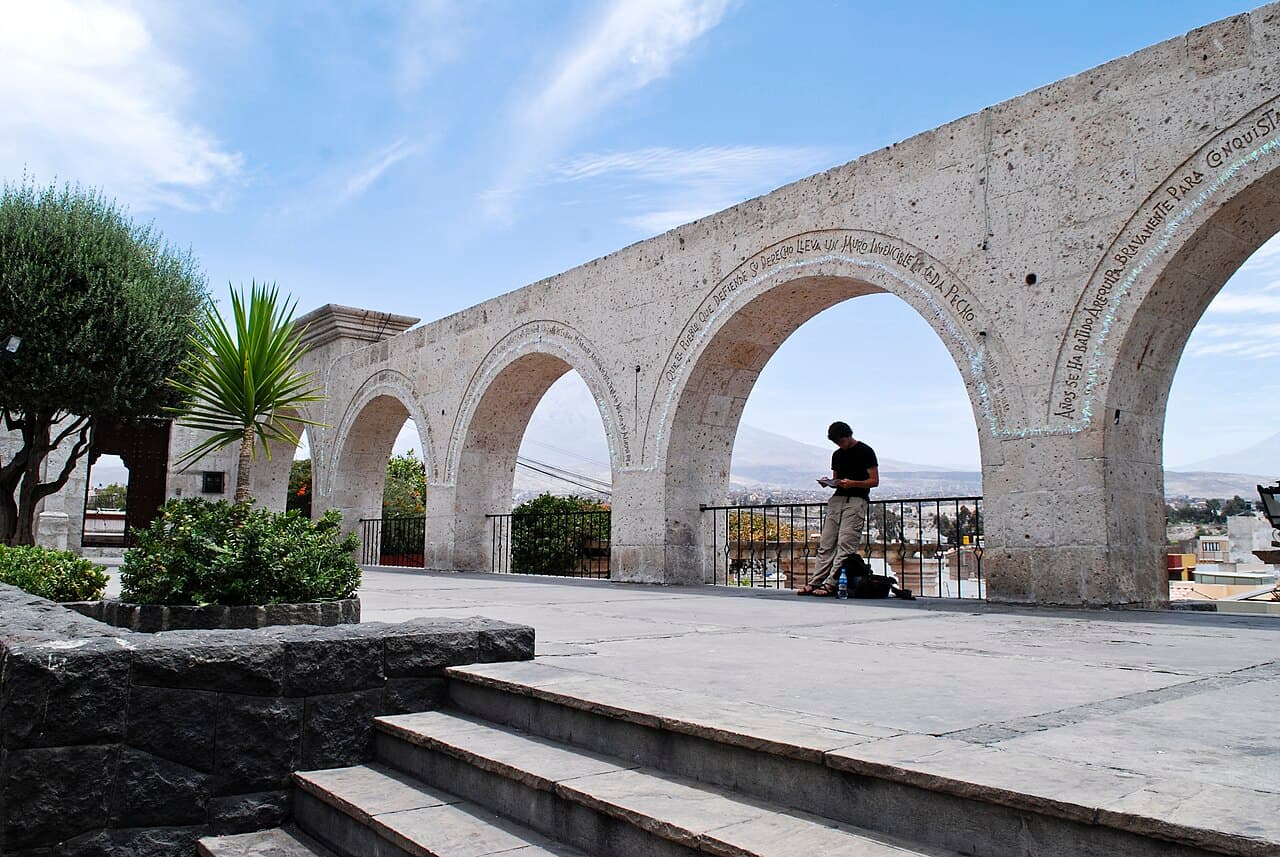
The twelve sillar-stone arches of Yanahuara's viewpoint are the most iconic frame for El Misti that exists, and every Sunday the artisan fair beneath them fills the White City's quietest neighbourhood with colour and aromas. Those who come only for the view miss half the experience.
The combi to Yanahuara leaves from Avenida Ejército for two soles and arrives in fifteen minutes. By InDriver taxi from the Plaza de Armas the fare is between S/ 6 and S/ 8. The reason almost everyone goes is the same: the twelve white sillar-stone arches of the viewpoint in Yanahuara's main square, built in 1953 on the initiative of Mayor Luis Vinatea Lazo, frame El Misti with a precision no other point in the city can match. Each arch has engraved in stone a phrase from an Arequipeño intellectual — Luna Pizarro, Jorge Polar, Zegers — and the ensemble functions as an open-air civic pantheon. At seven in the morning on a winter Sunday, the volcano appears completely snow-capped behind the arches and the light is so good that people photographing with their phones spend half an hour before they can leave.
Iglesia de San Juan Bautista and the Colonial Neighbourhood
The Iglesia de San Juan Bautista de Yanahuara, founded in 1750 and completed with its current facade in 1783, is one of the few examples of Baroque mestizo architecture to survive the earthquakes of 1868 and 2001. Its sillar facade has three niches holding images of Saint John the Baptist, Saint Francis of Assisi, and the Virgin of the Assumption, and its single bell tower dominates the laurel-ringed square. The interior preserves a locally made eighteenth-century gilt altarpiece and two paintings from the Cusco school. The 7:30 Sunday mass is the most attended: neighbours in shawls, women in straw hats, and the occasional confused tourist who didn't realise they were walking into an actual service share the dark wooden pews. Entrance is free outside of service hours.
The blocks immediately around the square are mostly residential, with late-nineteenth and early-twentieth-century houses mixing white sillar and red brick. Calle Jerusalén, which descends from the square toward the Chili River, is the most photogenic: wooden balconies painted blue, geraniums in clay pots, and a lateral view of El Misti that appears at the end of the street when the weather clears. The neighbourhood has no tourist restaurants or souvenir shops to speak of; what it has is four or five corner bodegas with cold beer, fresh cheese, and bread for three soles a bag.
Yanahuara doesn't show off — it simply exists, and in a city as self-conscious as Arequipa, that is enough.
The Sunday Fair: Artisans, Food, and Alpaca Wool
Every Sunday from 8:00 to 14:00, Yanahuara's square and the three streets around it fill with the weekly fair. Stalls belong to both regular artisans and itinerant sellers: alpaca textiles from Puno and Cusco communities (blankets from S/ 35, jumpers from S/ 80), ceramics from Quinua and Arequipa workshops, silver jewellery with pre-Hispanic motifs, and a dozen food stalls serving chicken broth, chicharrón with mote, baked empanadas, and queso helado. Prices are negotiable at craft stalls; at food stalls they are fixed. The best time to arrive is between 8:30 and 10:00: fewer people, rested artisans willing to talk, and the sun at exactly the right angle for the viewpoint arches to cast shadow without blocking the view of Misti.
Over the past three years the fair has added a section for local producers selling direct: honey from the Majes and Vítor valleys, Arequipeña olives from Tambo (500-gram bags for S/ 12), dried oregano from the sierra above La Unión, and chicha de guiñapo in clay pitchers at S/ 3. There are a couple of second-hand book stalls — mainly in Spanish, with the occasional English title — and a flower seller who has occupied the same spot for thirty years and saves the best roses for her regulars.
Eating in Yanahuara: Picanterías That Endure
Yanahuara has two picanterías that have occupied the same premises for over forty years. Picantería La Lucila, at Av. Dolores 111 two blocks from the square, opens Tuesdays and Fridays from 11:30 until the food runs out, usually between 14:00 and 15:00. It serves adobo, pork chicharrón, chupe de camarones on Fridays, and rocoto relleno every day. The set menu runs to S/ 35 per person including a drink. Tables are shared; if you arrive alone you sit with whoever is there. The sound of the brass band rehearsing on Sundays in the barracks next door bothers nobody — it is part of the atmosphere.
How to Build a Perfect Yanahuara Sunday
The ideal sequence for a Sunday in Yanahuara begins at 7:30 with the church mass — worth seeing for the interior regardless of one's faith — followed by half an hour at the viewpoint with thermos coffee before the 9:00 crowd arrives. From 9:00 to 11:00, the Sunday fair. From 11:30 onward, a picantería. The afternoon can be completed by walking down Calle Puente Bolognesi toward the Chili River, crossing the Puente Grau, and following the riverside path to Barrio San Lázaro in a twenty-minute flat walk. Yanahuara doesn't need to be the day's main destination — it works best as the beginning of one.
この記事はいかがでしたか?
アレキパが好きな人にシェアしてください。
アレキパに関する自分だけの物語がありますか?
記事を投稿する →